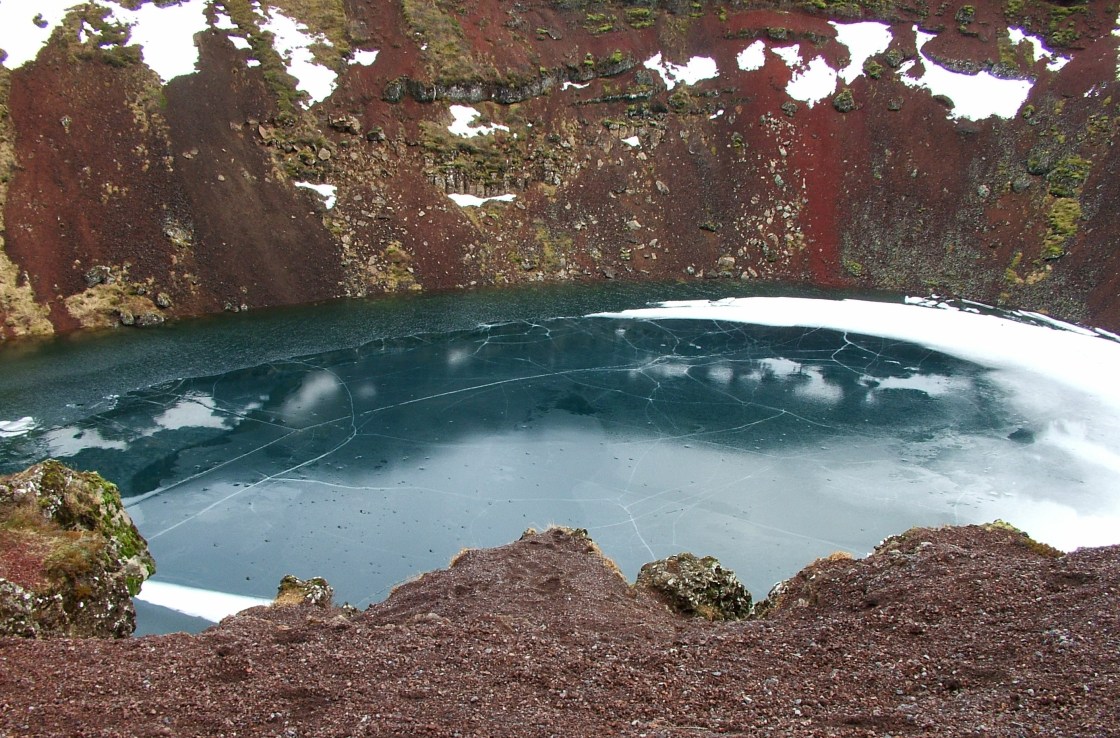
Since going to Iceland last year I have been fascinated by the country, and luckily there are loads of really wonderful blogs on WordPress which inform and delight. So many bloggers very kindly share their photographs; I was only in Iceland for three days so although we did lots and lots of differnt things, my experience was very limited… but enough of a taster to want more! One place we went was Kerið, a huge volcanic crater with brilliant blue water.
Iceland is a country of dramatic landscapes, mountains, valleys, glaciers, volcanoes, basalt rock formations, waterfalls … I am determined to go back one day and see more, and maybe go at a different time of year to see the country in a different light.
Yesterday I found a blog which had some amazing pictures of Lakagigar:
http://harrienijland.wordpress.com/2013/04/21/lakagigar-iceland-prt3/
The writer explained that the name means ‘craters of Laki’ and it is the site of an enormous volcanic explosion and eruption on June 8th 1783, the effects of which were felt across the world. This eruption went on for eight months… yes eight months! Half the livestock in the country died, and about one in four of the population… devastating; it must have taken generations to recover. The effects in other countries were profound, indeed, it may even have contributed to the French Revolution
I was intrigued and looked it up to find out more. Laki isn’t a single volcano but a volcanic system in south-east Iceland. Iceland was under the rule of Denmark, Reykjavik was a small town at the time. When the eruption occurred it must have been a phenomenal sight, fountains of lava shot nearly five thousand feet in the air; the poisonous gases reached even higher, an estimated ten miles up into the atmosphere. How terrifying it must have been, how powerless the people to save their animals poisoned by toxic gas, and themselves from the unimaginable event. It is said that after the event the people stopped dancing, and all their old folk dances (which their Scandinavian cousins still have) are lost for ever. The event is known as Móðuharðindin, which means The Mists of Hardship’.
As I mentioned, the effects spread across the world; the eruption effected the monsoon in Asia and Africa, even effecting the flow of the Nile because of the lower rainfall. This led to a famine in Egypt, where up to ¹/6 of the population died. North America, Denmark, Norway, Bohemia, France, Germany and Britain all experienced weather disturbances, falls of volcanic ash, poisonous smog, and other frightening effects of the distant event. Thee may have been up to 20,000 deaths in Britain because of it.
Although many Icelandic people died as a direct result of the eruption, many, many more died of starvation as a result of loss of their animals ( 80% of sheep, 50% of cattle) and damage to their crops. The winter which followed was extreme and harsh and resulted in more premature deaths.
Now, tourists visit, people take photos on their holidays, but I am sure all of them who take notice of the information about the area, will be moved by the terrible event 230 years ago.

 Lois Elsden