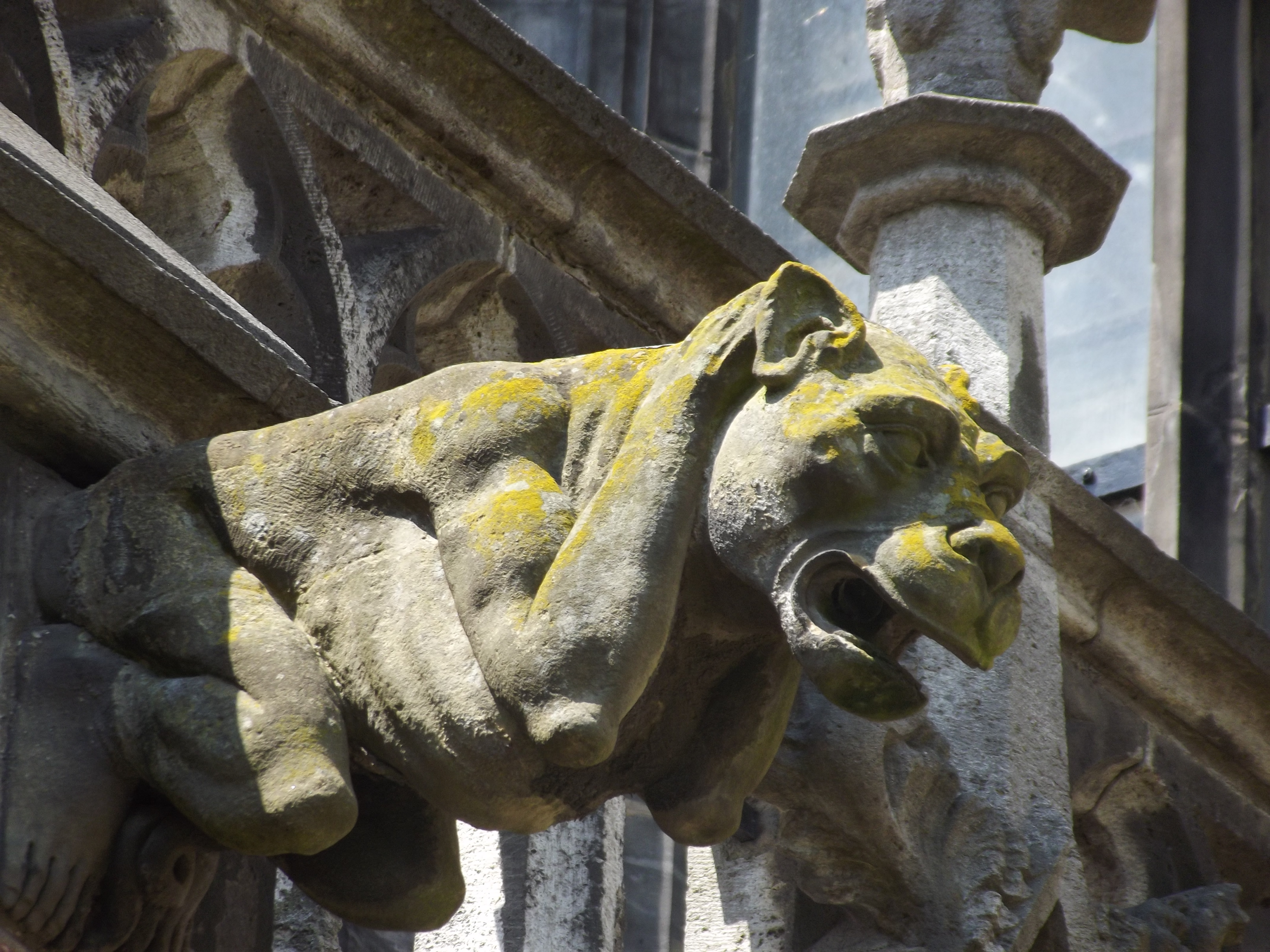
 There is something fascinating and endearing about gargoyles… I think there have been many children’s stories about them, although now I’m writing this none come to mind.
The word itself is from French and originally Latin, and is connected to the words gargle, gurgle and gullet in English.
From when people first started using mortar or cement to fix stones together in building, they must have realised that heavy rain can wash it out and make the building unstable. With wattle and daub houses and buildings, thatch was designed to protrude over the walls to keep the rain away from them. At some point stone building architects must have realised that just an overhanging roof was not enough, and designed a conduit to take the water away from damaging the mortar. As building became more sophisticated and decoration was brought into the design, heads with holes as water spouts began to appear, in ancient Egypt, in ancient Greece, there are many examples of creatures and human faces and the Etruscans and Romans also used them.
In the middle ages as church and monastic buildings grew in height and stature gargoyles were an important feature to protect the walls…. and they became more and more elaborate and fantastical. Heads of creatures appeared inside these buildings, not as water spouts but just as decoration… I’m sure the masons who made them must have enjoyed this aspect of their work, letting their imaginations have free reign. I’m sure some of the heads were symbolic, but I’m also sure a lot of them were just for fun! It was only when drainpipes began to appear in the early eighteenth century … I guess people got fed up with the fountains of water cascading from above, and maybe there was the idea too of collecting and conserving the water rather than letting it splash down., that gargoyles began to disappear. They were very heavy too, and apparently some people found them frightening. In 1724 there was an Act of Parliament in London requiring all new buildings to have drainpipes.
This lichen-mantled gargoyle can be found in the cloisters of the Cathedral of St Martin in Utrecht.

 Lois Elsden
One Comment