As part of my on-line course on Shakespeare and his world, there is a voluntary assignment… I decided to look at paintings and sketches by Henry Fuseli. The course is led by Professor Jonathan Bate from Warwick University, and uses the wonderful resources of the Shakespeare Birthplace Trust, at Stratford-upon-Avon.
This is what I wrote;
Henry Fuseli was born in Zürich in 1741, and read Shakespeare, in translation, while a student. At the age of twenty-three he moved to London, where he remained for most of the rest of his life, becoming a professor of painting at the Royal Academy. As a young man, not long in London, he visited the theatre, and once saw the great David Garrick and Mrs Pritchard in a production of Macbeth. This must have made a deep impression on him; he was still painting scenes from the play fifty years later. Fuseli died in London in 1825, at the age of eighty-four.
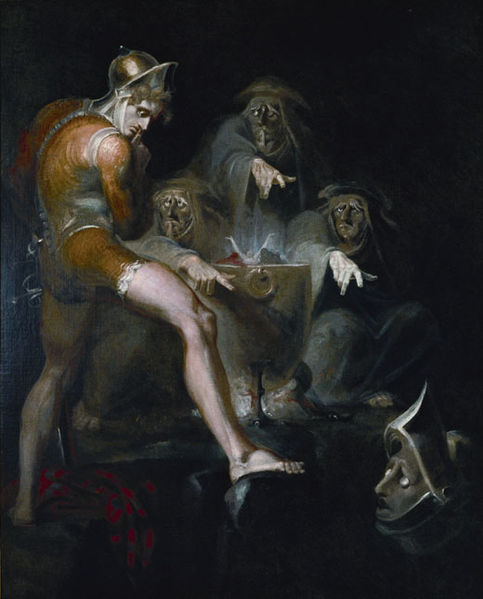
The work I am going to consider is by Fuseli and from Act IV, scene (i), Macbeth Consulting the Vision of the Armed Head.
http://en.wikipedia.org/wiki/File:Macbeth_consulting_the_Vision_of_the_Armed_Head.jpg
Macbeth can be seen staring intently at the helmeted head, the three witches pointing at it but their eyes fixed on Macbeth. Macbeth appears virile and strong, he does not seem to show fear of the witches, greeting them as ‘secret, black and midnight hags’. In another painting by Fuseli, of Macbeth after the murder of Duncan, he is shown as a man riven by the foul deed he has committed. In this painting of him accosting the witches in their den, he is again the fearless warrior, dominating the scene, the man described in the very first act as ‘brave Macbeth’.
The ‘armed head’ is staring back equally intently, and warns Macbeth of Macduff, the Thane of Fife. As we look at this painting, we know that by the end of the play, Macbeth’s head will be hacked from his shoulders, as this ‘Vision’ is. On the Tate Gallery website, the comment is made that Fuseli intentionally likened the ‘Vision’s features to Macbeth’. (http://www.tate.org.uk/whats-on/tate-britain/exhibition/gothic-nightmares-fuseli-blake-and-romantic-imagination/gothic-3)
The witches are not grotesques, but their faces are shown almost like masks. Banquo describes them early in the play “you should be women, and yet your beards forbid me to interpret that you are so,” and Fuseli shows them here as almost androgynous, with no clear gender. Professor Bate points out that initially Macbeth asks ‘what’ not ‘who’ they are, and Fuseli very clearly paints the weird sisters as ‘creatures from an elder world’ (Holinshed’s Chronicles)
We have learned that the term ‘witches’ at the time of Shakespeare could describe a variety of different people fulfilling different roles in society, they were not just evil, their magic was not just ‘black’. However in Act I scene (iii) Shakespeare’s witches do cast spells; one of them has been ‘killing swine’, the other has been causing mischief to a ship’s master. Their function for Macbeth is as seers, foretelling the events which will come to pass, and Fuseli’s depiction of them in his ‘Armoured Head’ painting seems to be as oracles.
Professor Bate highlights the role of the witches as ‘ creatures of imagination’ and maybe this is what appealed to Fuseli, who painted other works with a strong psychological aspect; he was fascinated by the inner workings of the mind, and how that might be portrayed on the stage… or on canvas.

 Lois Elsden
