
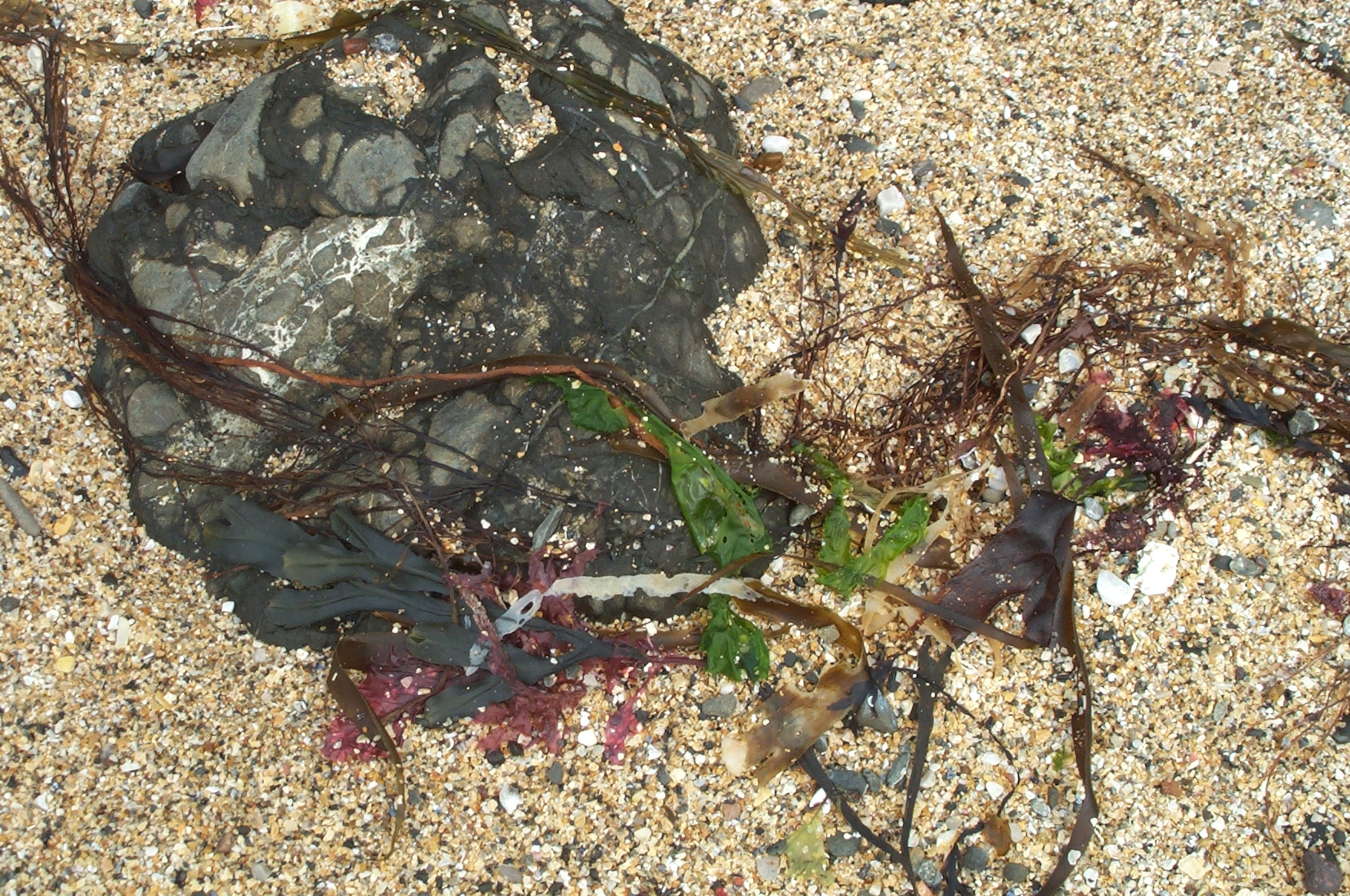
I guess when we’re on the beach we don’t pay much attention to seaweed; we might think how pretty it is, lying strewn across dam sand, or floating gently in rock pools; we might think how yucky it is as we tread on it or it brushes against us as we swim; we might be vaguely interested in it and wonder what the different sorts are called; we might pick it up to take it home because it looks nice, or it reminds us of our lovely holiday, or we want to hang it up to forecast the weather… we might even wonder if we can eat it, and we might even try!
If you actually thought about it, you would know that there are lots of different sorts and varieties, including, brown seaweed, wrack, kelp, green seaweed and red seaweed. They are so really useful, for example: food – for humans and animals, seaweed baths and cosmetics, agricultural fertilise, and the sort of seaweed which makes jelly or gum, alginates, agars and carrageenans.
Seaweeds are over 1,200 million years old – not the stuff you see floating about, but the plant as a thing, and there are over 11,500 different varieties which have been identified… so far!

 Lois Elsden
Is seaweed related to lichens? Not kidding this time.
LikeLike
It’s an algae… so I guess they are distant cousins! I think lichen mums married algae dads… something like that!
LikeLike
Indeed, it’s a popular food in South Wales. We eat masses of laverbread, porphyria umbilicalis, traditionally with fried bacon and cockles. Delicious
LikeLike
I haven’t had laverbread for years but it is so delicious! I wonder if it is available anywhere else? If not I’ll just have to cross the Severn Bridge!
LikeLike
I couldn’t get it in Bristol when I lived there. You can get it mail order in tins
LikeLike
Hmmm… tins… doesn’t sound as good… I’ll have to cross the channel… I know there used to be a wonderful market in… um Newport? Cardiff?
LikeLike
Swansea has the best market but the ones in Newport and Cardiff are pretty good and both sell laverbread.
LikeLike