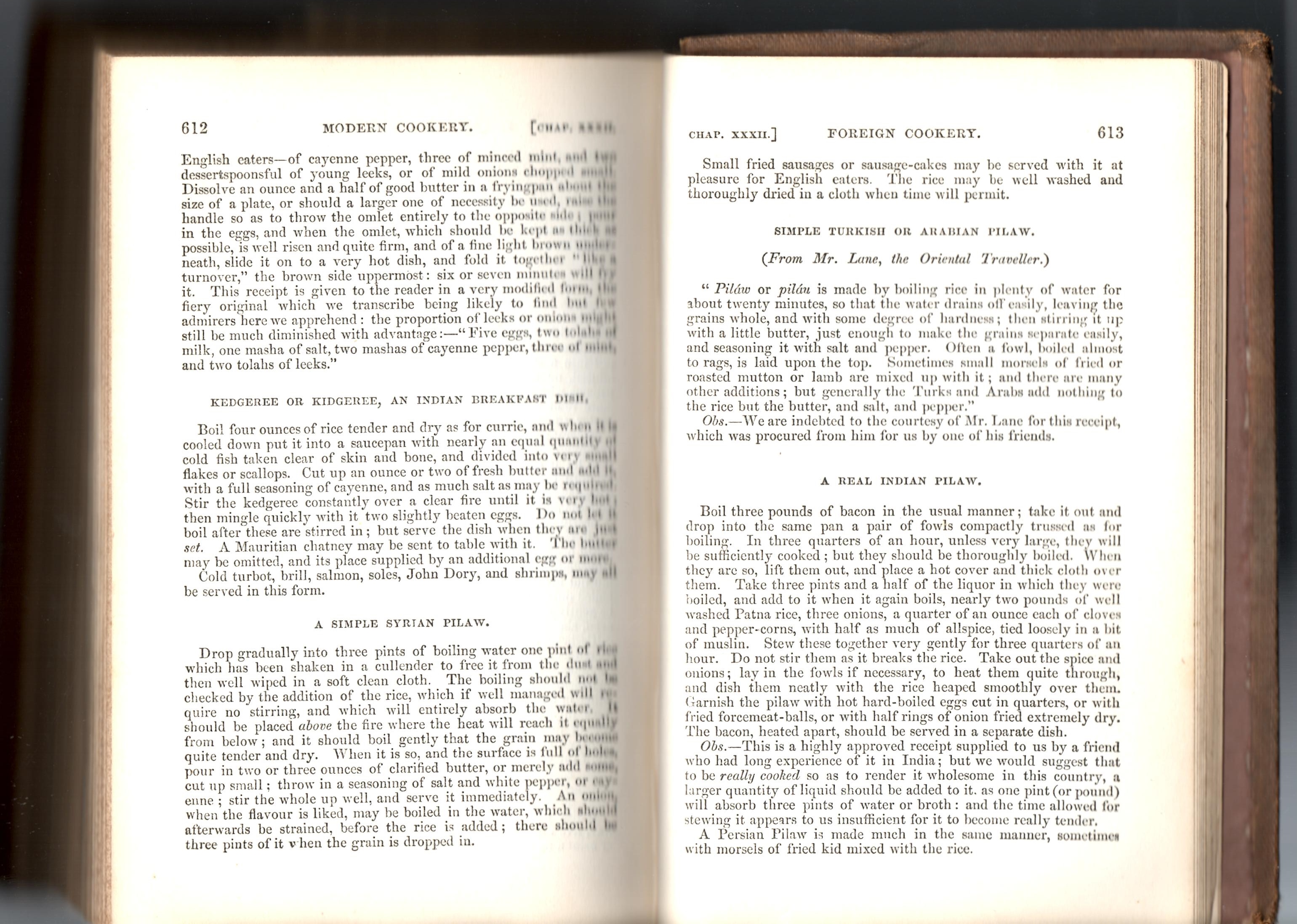
 This is a page from the section of Eliza Acton’s 1845 book Modern Cookery. There are four recipes on this page, one which started on the previous page for The King of Oude’s Omlet, and then here three pilaws and a kidgeree.
The omlet starts with five fine eggs “cleared in the usual way” (… I wonder what that means – checked if they were fresh I guess, but maybe strained?) whisked with two tablespoons of milk or cream, a small teaspoon of salt, one teaspoon – “or half that quantity for English eaters”- of cayenne pepper, three teaspoons of chopped mint, two dessert spoons of mild onions or young leeks chopped small. The omlet mixture is then fried in the usual way in an ounce and a half of good butter. At the end of the recipe she gives the King of Oude’s measurements of the ingredients, five eggs, two tolahs of milk, one masha of salt, two mashas of cayenne pepper, three of mint and two tolahs of leeks.
I was interested in these Arabic units of measurement and there is a very interesting article on Wikipedia, but in brief,
- 8 rattīs = 1 māshā
- 12 māshās = 1 tolā
- 80 tolas = 1 ser
- 40 sers = 1 maund
- 1 rattī = 1.75 grains
These weights and measures had been regulated by the Emperor Akbar, however once the British traders arrived In India, they standardised the system still further. From 1833 the rupee and tolā weight was fixed at 180 grains; apparently originally one maund was said to represent the weight unit for goods which could be carried over a certain distance by porters or pack animals.
http://en.wikipedia.org/wiki/Indian_weights_and_measures
Oude (Ayodhya), by the way is what is now Uttar Pradesh, an area which was famed for its cuisine.

 Lois Elsden
One Comment