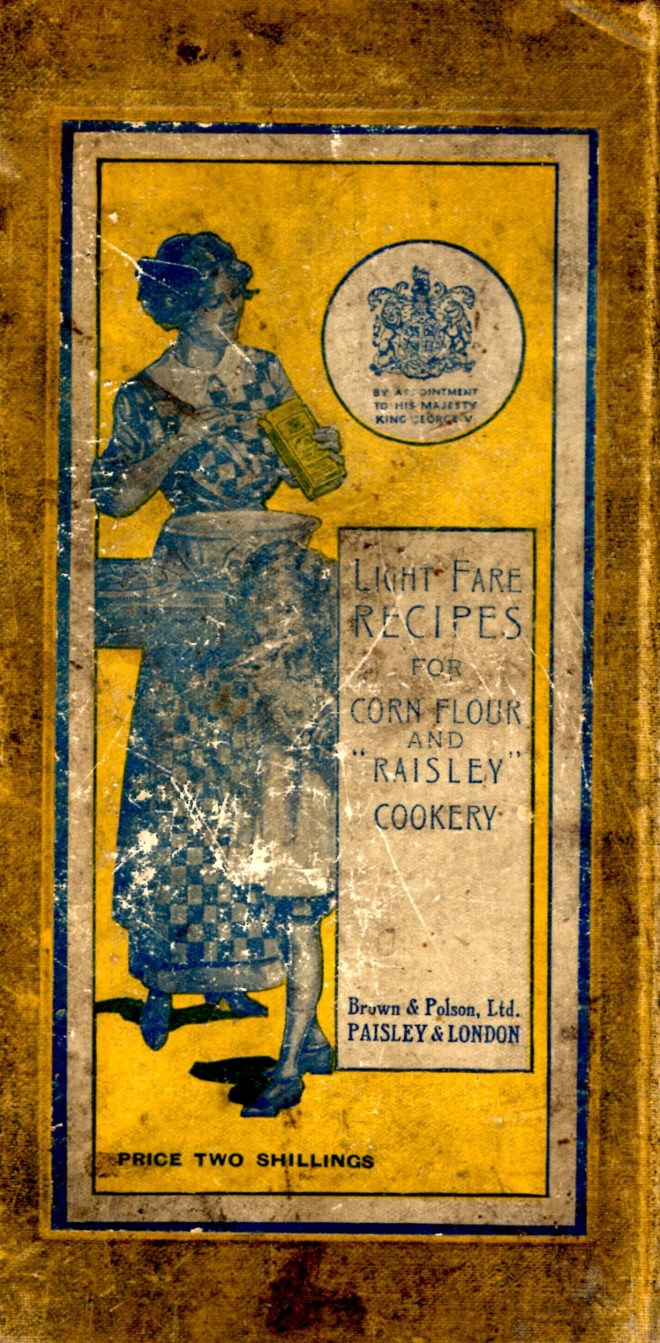
I love old cookery books… not just such classics as Mrs Beeton’s Book of Household Management, Hannah Glasse’s The Art of Cookery Made Plain and Simple, and my favourite Eliza Acton and her Modern Cookery… but the cheap little books and booklets that housewives would have had years ago, maybe published by food producers such as Be-Ro, Spillers or McDougall.
I have one issued, I would guess, between the wars, and it is full of practical and helpful recipes, with a hangover from nineteenth century books of sections including chafing dish cookery, table jellies, invalid dishes and savouries. There are whole sections on vegetable sauces, hot suet puddings and buns.
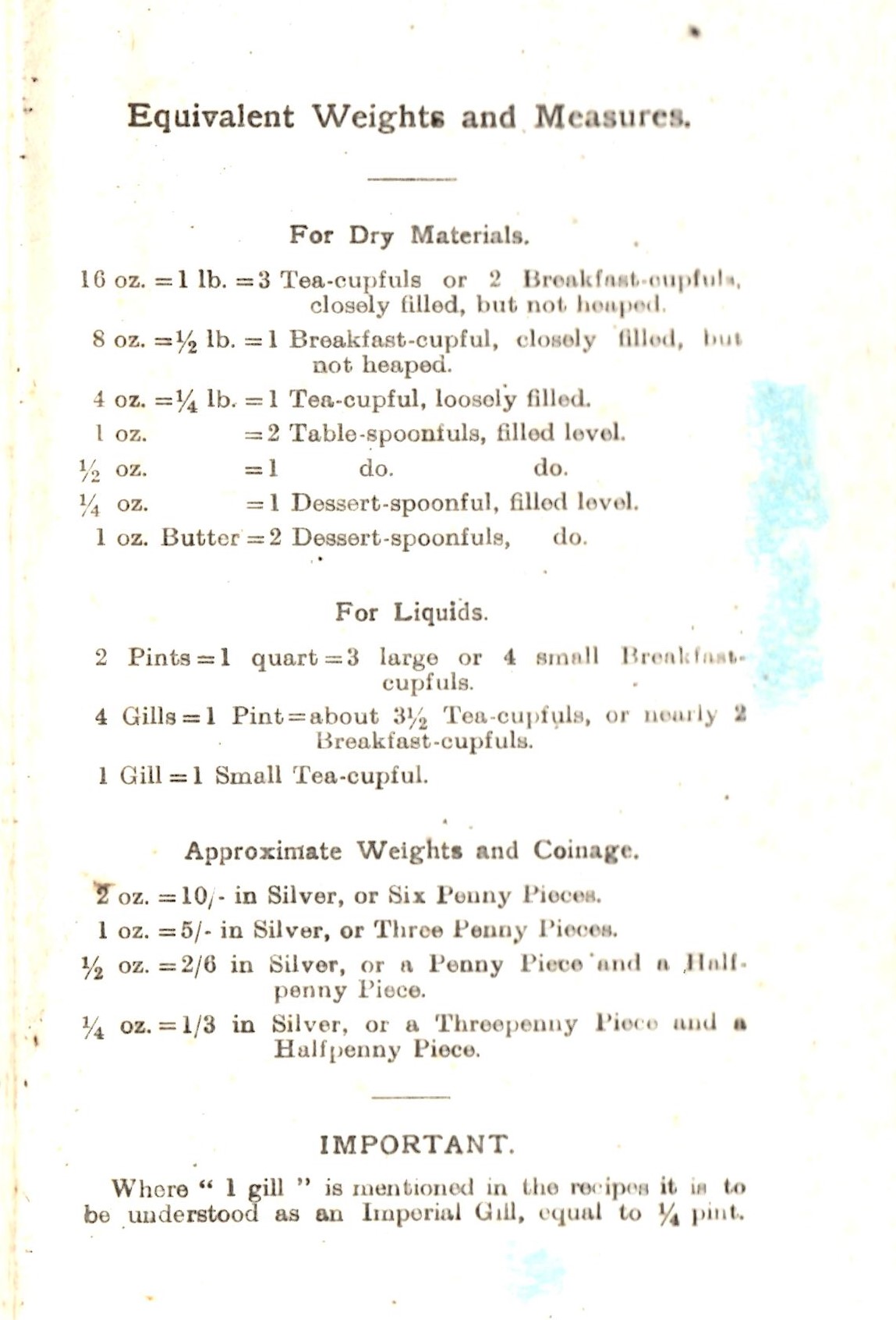
In the back is a helpful guide to equivalent weights and measures – for cooks who didn’t have scales, and for many less well-off families this would have been a consideration. For cooks in Britain these days we are used to looking at American recipes where the ingredients are given in cupfuls, whereas we might have pounds and ounces of kilos and grams in our recipe books. However, here in the Brown and Polson cookery book, ‘Light Fare Recipes for Corn Flour and “Raisley” Cookery’ cup measures are helpfully given in a table at the back.
In this book there is a difference between breakfast and teacups… 2 breakfast cups equal 3 teacups full of something, ‘closely filled but not heaped’, and ‘loosely filled’. That comment on how they should be filled is very helpful, I think! In the following section the different size of cups is commented on and it now seems according to this, that there are large and small breakfast cups
- 2 pints = 3 large Breakfast cupfuls
- 2 pints = 4 small Breakfast cupfuls
- 1 pint = ‘about’ 3½ Tea cupfuls
- 1 pint = ‘nearly’ 2 Breakfast cupfuls
There is also a way of weighing, but in quite small amounts, by using coins, and again it is interesting to see how the coinage was very different then. The weight is equivalent to an amount of money and the coinage used to make that amount.
- 10 shillings (ten coins) or 6 penny pieces (six coins) = 2 ounces
- 2/6 (two shillings and sixpence,a single coin also called half a crown) or 1 penny and ½ penny pieces (two coins) = ½ ounce
- 1/3 (one shilling and a threepenny piece which were ‘silver’) or a threepenny piece and one penny = ¼ ounce
I think some people think cooks in the olden days were not as precise and careful s we are with all our modern gadgets and electronic gadgets… they were just as concerned with following a recipe correctly, even though it might have been more difficult for them!

 Lois Elsden