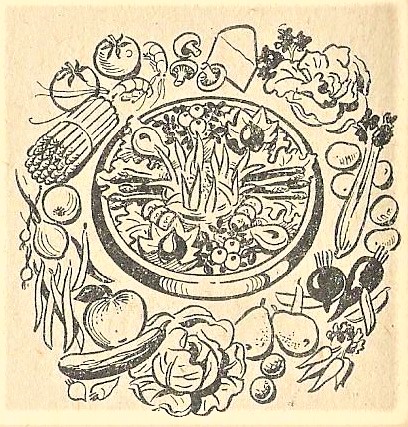
‘Cookery To-day and To-morrow’ is an interesting little cookery book by Nell Heaton, published in 1944. In her introduction she doesn’t refer directly to the war, but she does mention that malnutrition is found ‘amongst those who are short of food’ and ‘foods that are a luxury to some are everyday fare to others,and this is due to the available supply, economic and geographical conditions.’ It wasn’t just food in short supply during the war, at the end of her introduction, Nan comments that she hasn’t included as many recipes as she would have wished, nor ‘set out the ingredients in all sections‘ because paper was also rationed. This is apparent int eh quality of the paper, and the small size of the book and its font.
The last part of the book contains helpful information of all sorts, for example ‘if a proper steamer is not available it is quite simple to use stone jars and to place them in a large pan, with the water ¾ way up the jars’, and ‘if a proper pastry board or sheet of glass or marble is not available, the loose enamel tray from the top of the gas stove, or a piece of American cloth can be used.’ I had no idea what American cloth was, but Wikipedia tells me ‘oilcloth, also known as enamelled cloth or American cloth, is close-woven cotton duck or linen cloth with a coating of boiled linseed oil to make it waterproof.’
There are all sorts of useful hints – useful at any time but more so during the war – ‘to freshen stale rolls’, ‘to freshen rancid butter’ (you have to wash it then melt it, skim it, then drop in a piece of charred toast or charcoal! Now you know!) There are recipes for salting beans, pickling meat, and curiously, how to make cutlet frills: ‘Prepared cutlet frills may be obtained from the shops , but if in an emergency you wish to make one at home…‘ and there follows instruction on how to make them. There’s a hint on how to improve tinned fish – fish wasn’t rationed during the war, but it was so dangerous for fishermen to go out in their trawlers, and hundreds of the bigger fishing boats were requisitioned. Maybe the standard of the fish that was tinned was also compromised, but I think the fish must have been pretty dreadful if this improved it: remove fish from tin and place on a plate, pour on boiling water, drain, turn the fish over and repeat this process. Drain again and use as required.
Butter was rationed, as little as 2 oz per week so Nell’s tips on how to stretch the butter ration must have been very helpful – although, looking at her recipe, it seems that it was to make a white sauce with cornflour, ¼ pint of milk and 4 oz butter, beaten until smooth, then cooled and set. It sounds odd and rather horrid to us, but we have the luxury of not living on rations. As well as everything else, home-made remedies for minor injuries and illnesses were necessary – and Nell includes two: (i) to make bran poultice – place bran in basin, pour on hot water (or boiling vinegar), add a pinch of mustard if desired,mix to a stiff paste, place in a flannel bag (ii) to make a bread poultice – pour boiling water on sliced bread, cover and allow to stand for a few minutes, strain and break up the bread, apply in a muslin bag or direct to the skin. I shall bear that in mind, should I need a poultice.

 Lois Elsden
My Mam and Aunty used to talk about “Snook”, a tinned fish during rationing that they hated, and also having to eat whalemeat, equally disgusting apparently. My Dad was a big advocate of the bread poultice, was good with carbuncles apparently. I never saw him using a bread poultice, nor was I ever aware of him having a carbuncle. I guess there’s some science to it, mouldy bread contacins penicillin I think.
LikeLiked by 1 person
Carbuncles! I never saw one, although my mum had a big scar on her shin where she’d had one as a child. I had never heard of snook, but husband has – whether he actually had it as a child I’m not sure, he doesn’t like fish so maybe that’s the reason!
LikeLike
Snook (Snoek) is a South African fish similar to mackerel that was shipped in millions of cans to the UK during WW2. My older relatives hated it! I think carbuncles are boils, but I don’t know anyone who has had either. I wonder why they’re not common these days?
LikeLiked by 1 person
Yes, I always thought it must be like a boil – do you think it’s down to better nutrition these days, or hygiene? I must investigate!
LikeLiked by 1 person
I wonder? A bit of both maybe? I think a boil / carbuncle is an infection, so better nutrition, public health, housing would help improve immune systems I guess.
LikeLiked by 1 person
I know my mum had a deep scar on her shin from a carbuncle when she was a child (1930’s-40’s) Although the family may have thought of themselves as genteel, in fact they were in quite straitened circumstances and my mum and her sisters were often hungry. Maybe that caused her to have carbuncles, I wonder?
LikeLiked by 1 person