In my final teaching post I was working with young people in their last year of statutory education, who had, to put it bluntly, been kicked out of school. I’ve enjoyed all the different teaching posts I’ve held, but this, my final stint, was probably the most enjoyable, and definitely the most rewarding. I met and taught some brilliant students, some with very difficult and unfortunate histories, some who had made wrong choices, some who had been immature and got themselves into difficulties, and some who had struggled in challenging situations without the best support. There were idiots too, but we’ve all been idiots at some time, however for these young people the consequences had a critical impact on their education. In the year they were with us, most of them managed to turn their lives around and left us to go on to further education or training, or a job.
As usual, my preamble may seem not to have much to do with what I’m about to talk about (I mean write, but I always feel as if I’m just chatting here) I taught English, and one of the areas was poetry – reading it and writing it, and almost without exception it was quite popular. I was surprised how many of the people I was teaching wrote poetry, or wrote lyrics, which meant we seemed to be on the right road to begin with. I was able to choose poems I thought they would enjoy and which would engage and challenge them, Carol Ann Duffy, Martín Esparda, Gillian Clarke, Robert Frost, Jon Loomis – I’ve forgotten other examples now. These lessons were enjoyable to me, and I hope they were for the students too.
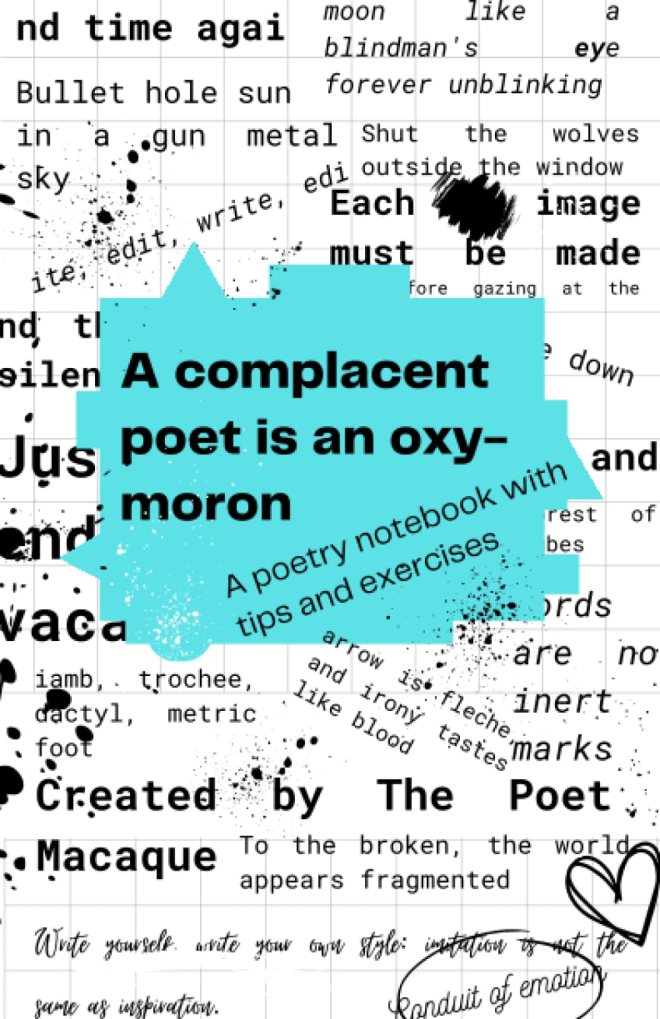
I didn’t have a text book, I found poems and created exercises for them. As well as studying poets and poetry, we had lessons writing poetry – and I had no text book or guidance for that either. I’m thinking about this because my poet friend Macaque has produced a poetry notebook with tips and exercises. His book is not specifically aimed at young people, but would be a great aid and stimulus to anyone who wants to write poetry or write better poetry. I guess there are many, many, many of us who fall into that category and I’m one of the ‘us’.
I wrote a lot of poetry when I was young, throughout my teenage years, and into my twenties, but story-telling began to dominate my writing. Over recent years I’ve written maybe half a dozen poems, and some poetic writing, and I have shared various here. However, I’m never very confident about what I’ve done – it sounds fine in my head, but spoken out loud it comes somewhat adrift. Now with Macaque’s book, ‘A Complacent Poet is an Oxymoron‘, I am challenging myself to write more, to practice and explore ways of creating poetic pieces, if not actual poems. Here is the blurb:
This ample lined notebook provides over 180 blank pages for writing poems, notes and ideas, as well as seminar notes and poetry workshop exercises to help improve technique. Course book and exercise book in one, it is the perfect combination for students of modern poetry. Produced by Macaque, a published poet and mentor, it is aimed at helping enthusiastic writers understand what poetry really means, and how to achieve the best results.
Here is a link to Macaque’s brilliant book, in case you too want to flex your poetic muscles:

 Lois Elsden