We were in Bridgwater the other day – it won’t surprise you if you know me at all. We wondered if the Blake Museum might be open – it wasn’t but we took note of its opening times so we could visit another time. It’s run by volunteers so its not surprising, also I’m not sure many people know of the General of the Sea and the Lord Warden of the Cinque Ports, Robert Blake. To quote from his entry in Wikipedia, “As noted by one of Blake’s biographers, Blake was responsible for the “… birth of a real British Navy … Hitherto, expeditions had been entrusted to Court favourites, whose main inspiration was not patriotism, but gain ; now, patriotism, not profit, was to be its watchword ; glory, not gold, its reward.”
We wandered away from the museum down Blake Street which has various narrow passages, and noticed a little stream – barely more than a trickle, passing beneath the road. This was Durleigh Brook which we guessed must be heading towards the River Parrett. I’m sure few people know of it, even residents of the town. I’d never noticed it before and I began to wonder where it sprang from and was there anything notable about it.
It didn’t take long to discover that Durleigh is a tiny village, just over a mile and a half southwest of Bridgwater, and its name means ‘deer wood’. it has the remains of a manor, now known as West Bower Manor (formerly Durleigh Manor) once held by the Seymour family and Jane Seymour is well-known as the third wife of Henry VIII, mother of Edward VI. Durleigh Brook was dammed in 1938 to for the Durleigh Reservoir specifically to provide water for the British Cellophane factory in Bridgwater which was opened inn 1937. The factory closed in 2005, with a loss of many jobs.
Now Durleigh Reservoir has a much more pleasant use – as a leisure facility for people to fish, for sailing and sail-boarding and apparently wind-surfing. There are many wild fowl on the water, no doubt delighting bird-spotters. More excitingly, there are plans to create not one but two wetlands by a company called Five Rivers:
The scheme involved excavating two wetlands on the same site. A naturalised wetland was designed to capture course sediment and silt by connecting the Durleigh Brook back to its floodplain. The other, an engineered wetland, was designed to improve the quality of supply from the Bridgwater and Taunton Canal, and also recycled water from the water works with respect to sediment, nutrients and pesticides.
https://five-rivers.com/case-study/durleigh-wetlands/
I think we might have a little adventure to the reservoir, and also to see if there’s anything happening to the wetland schemes.
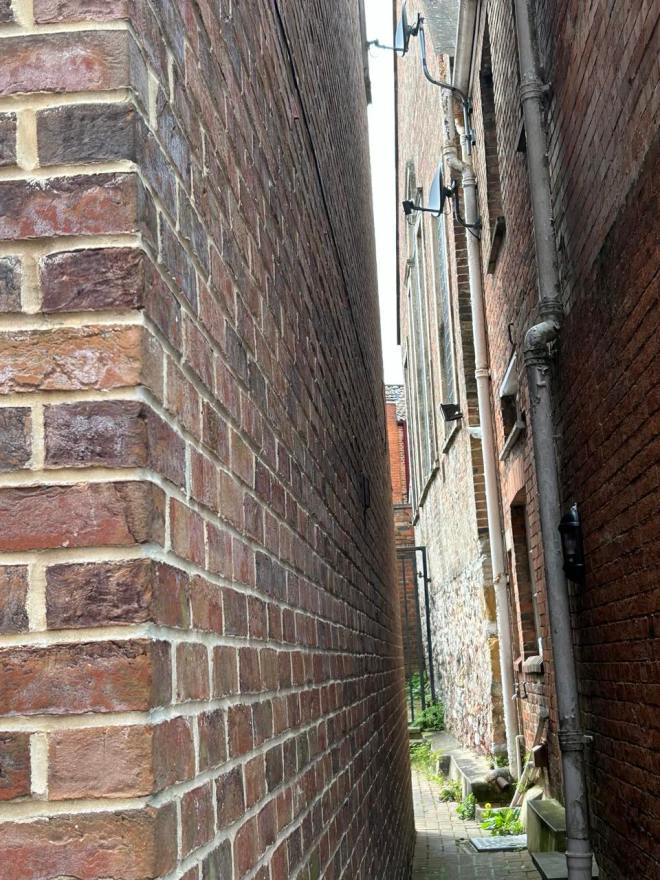
My featured image is of another little passageway running off Blake Street

 Lois Elsden