I have to confess that our cooker and oven has reached a point of being an absolute disgrace – it needs a complete and thorough deep clean and not just a squirt of kitchen cleaner and a wipe with a damp cloth. I won’t go into details of the horror of its neglect, if you’re brave enough you can imagine it.
I came across this list of tasks to clean a kitchen range, from Jane, who was born in 1891, three years after my grandma:
- remove fender and fire-irons
- rake out all the ashes and cinders; first throw in some damp tea-leaves to keep down the dust
- sift the cinders
- clean the flies
- remove all grease from the stove with newspaper
- polish the steels with bathbrick and paraffin
- blacklead the iron parts and polish
- wash the hearthstone and polish
- light the fire and when enough heat, set on the kettle
I wrote about bathbricks – or Bath bricks as they originally were – some time ago:
In the 1830’s William Champion and John Brown seem to have separately patented Bath bricks, but there were many other brick makers making them; at the height of their popularity there were at least ten different brick makers who made Bath stones. They were experts in their craft and knew all about the different properties of the different materials they used, and they realised that they could make a type of brick from the river bank silt . two hundred years ago, instead of thinking of silt as a nuisance, it was a valuable material to be harvested every few months from square pens which were built to trap the silt on this tidal river. It would be processed, ground up by a horse-driven machine, shaped into bricks and fired in the many kilns beside the river in the brick yards.
The bricks were in handy sizes, about two to three inches, and could either be used when wetted to rub on things like knives and other metal tools and implements to polish and clean them, or they could be scraped and the moistened powder used as a scouring agent just as we use scouring and cleaning powders today (often they are included in a cream cleaner) The siliceous powders could be used on larger surfaces such as floors.
The reason they were given the name Bath bricks was nothing to do with the city of Bath except for the fact that the finished bricks looked a similar colour to the stone quarried near Bath. An astounding twenty-four million Bath bricks were made per year at the height of their use, and in WW1 they were part of a soldier’s kit.
These days you will only find Bath bricks in museums, although you might find bath bricks (lower case) made from soap these days! next time you use one, think of the original Bath bricks!
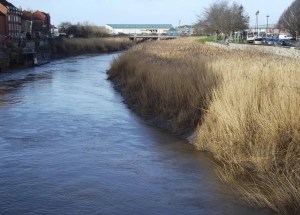
My featured image shows the River Parrett walls; beneath the rushes, reeds and grasses is silt… this rich resource is ignored and treated as a nuisance today, to be dredged and deposited on farm land. Within a couple of miles either side of the town bridge from where I took this picture, the particle size of the grit, and the algae content, is perfect for making the Bath Bricks

 Lois Elsden