I’m going to have a week of sharing past posts, and this one is about a man significant to British history, who many people will never have heard of. I shared this on this day six years ago:
27th September 2018
I guess if you asked the typical person on the street, who was Robert Blake, they wouldn’t know. Perhaps some older people might think of Robert Blake the American actor who was involved in a long murder trial, the victim being his wife… But the Blake I am thinking of is Admiral Robert Blake:
As with most people, there are periods in history I have a better knowledge of through studying at school and for my degree, the Middle Ages in Europe, Europe of the nineteenth century, the First World War. There are periods I have had a more personal interest in, the Neolithic and pre-Roman age of Britain, the so-called Dark Ages, Van Dieman’s Land… And I still have the same interest in discovering the past and the people who came before us. At the moment I’m reading ‘The Watchers: A Secret History of the Reign of Queen Elizabeth I’ by Stephen Alford.
I’m sure if you stopped ten, a hundred people in the street and asked them “Who was Admiral Robert Blake?” you’d be lucky to find anyone who knew the answer, except in Bridgwater Somerset. Here I’d hope more could give a basic response about who this great man was and what he did in the history of this country.

Robert Blake was the son of a Bridgwater merchant, born into a large family of thirteen children in Bridgwater in August, 1599, in the last years of Elizabeth I’s reign. His family must have been quite affluent because after going to the Grammar School, he went up to Oxford. On the death of his father in 1625, he returned home to Bridgwater, and, like his father became a trader. He had much commerce with the Dutch, and may have lived in Schiedam in the Netherlands for a while.
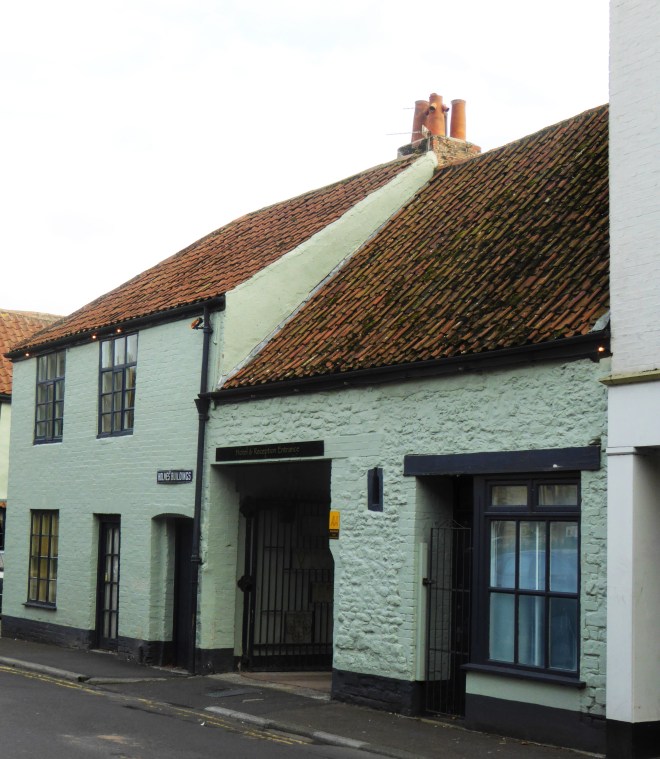
The family home where Robert was born, in Bridgwater
Robert became a Member of Parliament in 1640, although was only an MP for a year. When the English Civil War broke out, he was, as a strong Puritan, on the side of Parliament against King Charles I. He fought against the Royalists after joining the New Model Army despite having no military background. However, it was as a tactician that Robert showed his true mettle at the Siege of Bristol, July 1643. As a result he was promoted to Lieutenant Colonel. He brilliantly defended Lyme Regis in the Siege of Lyme in April of the following year and was promoted again, to colonel. As a West Country man he knew the south-west well and saved Taunton in 1645 during the Siege of Taunton. Later the same year he was in a different position, attacking and breaking the siege at Dunster Castle.

Robert returned to parliament again, in 1644, a popular local hero to the people of Bridgwater. Although a member of parliament during a most troubled time, he played no part in the trial and execution of King, Charles I, even thought he was a republican and committed Presbyterian.
With the establishment of The Commonwealth, the new regime looked to its sea defences, and the office of high admiral, although not called that, was commissioned. There could be only one man for the post; with his long experiences of trade and commerce, his travels in Europe, his military expertise as exhibited in the military campaigns, only Robert Blake of Bridgwater could be High Admiral. Robert became General-at Sea and in 1649 he sailed round the coast of Ireland to Kinsale, chased Prince Rupert of the Rhine’s squadron of privateers to Portugal. He then blockaded Rupert’s fleet in Lisbon harbour over the summer of 1650
Robert was not just a passive besieger here; he seized the Brazilian fleet of Portugal when King John IV refused to expel Rupert or acknowledge the Commonwealth of England. He pursued Rupert’s escaping fleet into the Mediterranean where all but one of the ships was wrecked and the survivor captured. Rupert sailed into the Atlantic, but Spain and Portugal were forced to recognize the Commonwealth.
Still fighting for Parliament, Robert captured the Royalist stronghold on the Scilly Isles in 1651. From there attacks had been launched on shipping, and after another siege, Robert finally caused Jersey to surrender. The following year he sailed again, this time against an enemy he knew better as a friend and trading partner, the Dutch. His experience from twenty years previously must have been invaluable in this campaign, the first Anglo-Dutch war; however Robert had to retire in 1653. His retirement only lasted a year, he was back in action on the seas in 1654 , cruising and fighting his way round the Mediterranean.
in the Anglo-Spanish War he spent a long bitter winter of 1564 at sea, blockading Cadiz which allowed the treasure-laden Spanish fleet home from the West Indies to be captured by Captain Richard Stayner. The booty from this triumph was worth over £2,000,000! This siege commanded by Robert is remembered as the first time in naval history where a fleet was kept at sea over winter. If you imagine the conditions the sailors and officers must have endured, it is an extraordinary achievement.
Robert’s greatest victory, however, was in April 1657 when he attacked another Spanish treasure fleet which had docked in the strongly defended harbour of Santa Cruz on Tenerife. Blake braved the shore batteries and sailed his fleet right into Santa Cruz harbour and bombarded the Spanish batteries and every single one of the Spanish ships in the harbour was destroyed without the loss of a single English vessel. Robert’s amazing and deserved success not only earned him the highest respect, but this victory was one for his country, its government, and its leader, the Lord Protector Oliver Cromwell. The Protectorate was now respected, and feared across Europe.
Robert was nearly fifty-eight, his health was suffering and he was forced to return home. His squadron was within sight of Plymouth, where a hero’s welcome awaited him, when he died on 7 August 1657, aboard his flagship the George.
He was buried at Westminster Abbey after a state funeral attended by Protector Cromwell and the whole Council of State.
“A hero of the Roundheads through his dogged defence of Lyme and Taunton during the civil war, he became an admiral under the Commonwealth and is regarded as second only to Nelson in British naval history.”
http://www.british-civil-wars.co.uk/biog/blake.htm
PS my featured image is of Bridgwater museum, teh family home of the Blake family

 Lois Elsden