I suppose it’s because we’re heading into the festive season and thinking about food and cooking which prompted me to look at my cookery books, and I realised there was one I’d bought, put on the shelf, and forgotten about, “Recipes For You” by Mary McKirdy. Mary was born in 1874 and was the niece of Margaret Black who founded the West End School of Cookery in Glasgow in 1878. When Margaret died in 1903 at the age of seventy-three, Mary, who had worked in the school for eight years, took on her rôle. Mary published her book in 1929 and although my copy has no date in it, I would guess it’s quite old, definitely pre-war. There are a couple of newspaper cuttings in it and I’ll see if I can find their date another time.
As with many cookery books, there is a section called ‘Odds and Ends‘ and unusually, it is the first chapter – followed by ‘Garnishes, Sweet and Savoury’, ‘Menus’, ‘Uncooked and Meatless Meals’, and twenty-four more chapters. ‘Odds and Ends‘ starts as most cookery books still do, with handy measures, but just reading them gives an idea of the age of the book:
- 1 level tablespoonful Butter, Lard, Dripping, Treacle, Sugar = 1 oz.
- 1 level teaspoonful Butter, Lard, Dripping, Treacle, Sugar = ¼ oz.
- 1 rounded tablespoonful Flour, Cornflour, Tapioca, or other light substance = 1 oz.
- 1 rounded teaspoonful of Flour = ¼ oz.
- 1 level teacupful Flour = ¼ lb.
- 1 level teacupful Butter = 6 oz.
- 1 level teacupful Sugar = 6 oz.
- 1 teaspoonful Baking Powder, Soda, and Cream of Tartar is a heaped spoonful.
- 1 gill ≈ 1 small teacupful.
- ½ pint = 1 small breakfastcupful.
As I copied this out I had to really concentrate on Mary’s use of capital letters, full stops and her compound word breakfastcupful, and her electric cooking and her confusing ‘1 teaspoonful Baking Powder, Soda, and Cream of Tartar is a heaped spoonful‘. I have no idea whether that was usual, I’ve never come across it before, maybe it’s a Scottish thing.
Here’s the first part of her instruction:
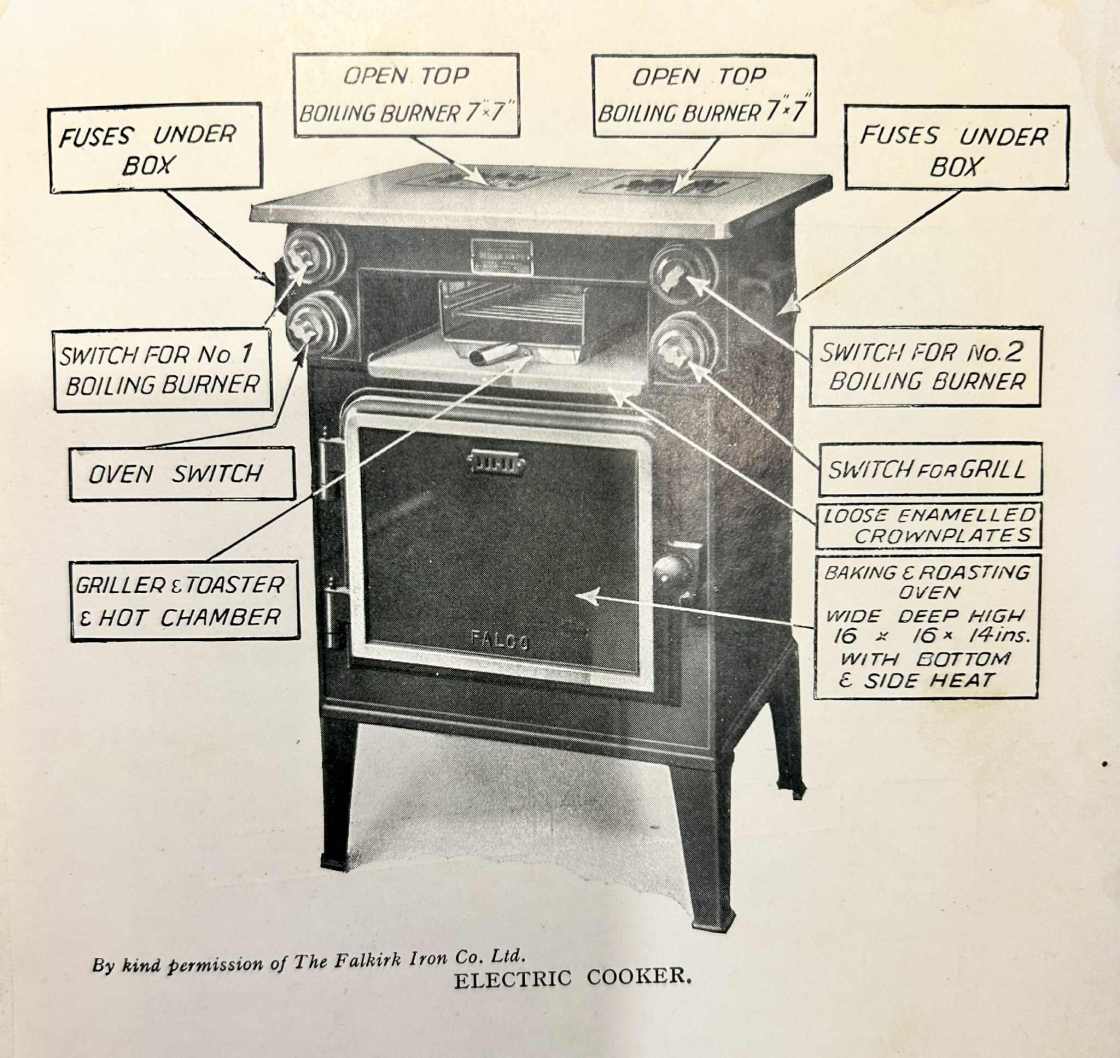
ELECTRIC COOKING.
In this age of domestic service problems, electricity with almost supernatural power, supplies all manner of labour-saving devices, in the form of sweepers, washers, cookers, and other fascinating appliances.
ADVANTAGES OF ELECTRIC COOKING. – To the busy housekeeper the most outstanding advantages are its cleanliness – no soot, no flues to clean, no ash, no black lead, no dust, no fumes, no smell, no grease, no matches or paper; clean pots and pans, wallpaper, ceilings, paint etc., and its safety. As electrical energy is direct transformation to heat energy without combustion or fuel, there are no fumes, smells, grease, or soot. The practically air-tight oven is free from draughts and dust. Electrical cooking has been proved to be quicker with a very small percentage of food shrinkage.
Remember – When the current has been turned off, the oven retains about two hours’ slow cooking heat suitable for finishing the cooking of a meat pie, the finishing of a cake, cooking porridge, rice pudding, custard, fruit, and many other things. It is in the observing and making use of this outstanding difference between electrical and other cooking that economy of consumpt can be obtained.
I have copied this exactly – it was written nearly a hundred years ago and language evolves and changes, but I’ve never come across ‘consumpt’ before, so unless it is a Scottish word, I fear it might be an error!
Part 2 tomorrow!

 Lois Elsden
Apart from the historical and cultural interest, I like the way you bring back to life some people who have long been forgotten.
LikeLiked by 1 person
Thank you so much, I really appreciate your comment!
LikeLike