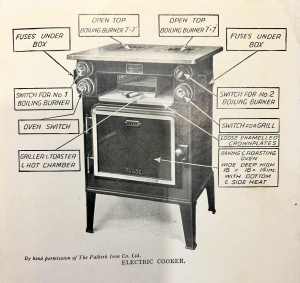
I shared an excerpt from a 1929 cookery book by Mary McKirdy yesterday, “Recipes For You” by Mary McKirdy. Mary was born in 1874 and became the principal of the West End School of Cookery in Glasgow in 1903. There is no introduction, it starts with a chapter “Odds and Ends” which in many cookery books comes at the end, all the useful little hints and tips which don’t fit in anywhere else. There’s a list of ‘Handy Measures’ in spoonfuls and cupfuls, and then a description and use of electric cookers, which I shared yesterday. Next came the all-important (and unpopular chore) task of:
CLEANING OF COOKER – Never use blacklead or an equivalent. Rub top with pad of soft paper. Rub stove inside and out, with exception of roof of oven, with a woollen rag dipped in olive oil, then rub vigorously with soft paper. The spiral heating element on top of the stove requires no cleaning; do not attempt to clean it with a sharp instrument.
ENAMELLED PARTS – Wash with hot water and soap; scour with salt, fine ash, or Brooke’s soap.
PANS TO USE – Cast-iron pans are excellent; also cast aluminium. When using two or more pans, let them touch, they become heat inducers, economising heat.
These instructions are for ‘electric cooking’, but in the 1920’s and 30’s, people still used coal stoves. I’m not sure if anyone does now, although maybe some range cookers use solid fuel – to be honest, I have no idea! It must have increased the housework no end, and I know even quite ordinary people would have had a young girl helping them at home. When my mum was a little child, the youngest of four, in the 1930’s, the family were living in a rented cottage and quite poorly off, but they still had a girl from the village live with them to help. I have forgotten her name now, but it may have been Ethel.
COAL STOVES
The flues and tops of ovens must be kept free of soot, if satisfactory results are to be obtained; the flues should be cleaned at least once a week, but the tops of ovens should be brushed every morning. Even a slight coating of soot acts as a non-conductor of heat, and this on the top of an oven will keep it from heating sufficiently
METHOD OF CLEANING FLUES – The diagram showing the construction of flues should be carefully considered, the cleaning will then be simplified:-
Remove the plate rack. Clear cinders and ashes from fire-box and ash-pan. Close up stove as far as possible to keep soot from escaping. Open dampers, sweep with a fine brush. Brush each flue in turn, beginning at the highest point possible, open one flue door at a time. Brush soot from top and sides of the oven, remove soot from lowest openings. Clean stove.
ECONOMY OF COAL – It is necessary that the cook or house-keeper knows how to manipulate the various dampers; these should be out only when a particular part of the stove has to be heated.
Gosh what a palaver! I sigh and herrumph at having to clean our cooker, using modern sprays and cleaners and with a ready supply of hot water!

 Lois Elsden