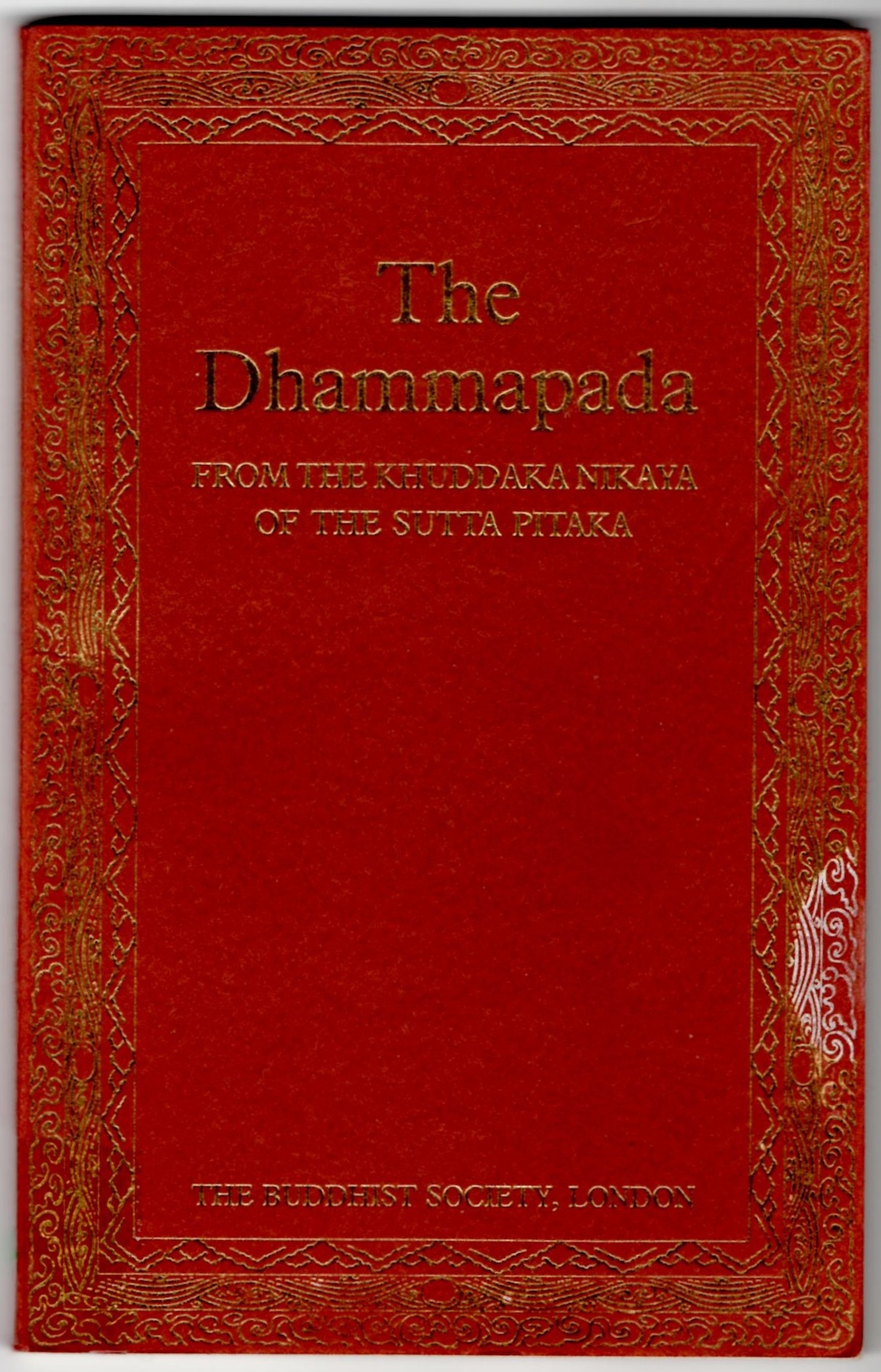
 A book I carry around with me and dip into frequently is the Dhammapada; my own copy is getting a little dog-eared, but only a little. While at the Buddhist Centre a week or so ago I was looking through their extensive library when I came across a different translation of my book and out of curiosity borrowed it.
This version is published by the Buddhist Society of London, and edited by Jack Austin whose aim was to present the scripture in a way which would be most open and understood, and appreciated, by English speakers. I am not scholarly enough to know which is the better translation; there is accuracy in a technical sense and then there is accuracy in the way the meaning is expressed so the reader properly understands the meaning…
My copy translated by Thomas Byrom, shows Chapter 3 ‘The Mind’, as follows:
As the fletcher whittles and makes straight his arrows, so the master directs his straying thoughts.
Like a fish out of water, stranded on a shore, thoughts thrash and quiver, for how can they throw off desire?
They tremble, they are unsteady, they wander at their will. It is good to control them and to master them brings happiness.
But how subtle they are, how elusive! The task is to quieten them and by ruling them find happiness.
With single-mindedness, the master quells his thoughts. He ends their wandering. Seated in the cave of the heart, he finds freedom.
How can a troubled mind understand the way? If a man is disturbed he will never be filled with knowledge.
The same chapter from the copy I have borrowed is like this:
As a fletcher straightens his arrow, so the wise man straightens his unsteady mind, which is so hard to control.
The mind struggles to escape the Tempter, as a fish thrown on dry land.
It is good to train the wandering mind. A mind under control brings great happiness.
The wise man guards his mind, which is unruly and ever in search of pleasure. The mind well guarded brings great happiness.
Those who bridle the wandering mind will escape the bonds of the Tempter.
If a man’s mind is unsteady, if he does not know the True Law, and if his faith wavers, he will never perfect himself.

 Lois Elsden
I like them both ( I am a sucker for Buddhist, Zen & Taoist texts) but I prefer the second as it seems to engage the conscious mind a little less, so make more sense without trying to understand.
🙂
LikeLike