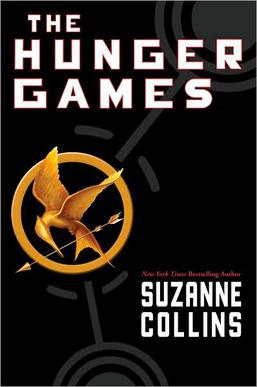
The Hunger Games is a trilogy by the author Suzanne Collins, and much as I ma prejudiced against the use of the present tense, her books are the very few where I think it effective and works and does not just seem like a silly, fashionable device.
http://loiselden.com/2013/08/28/narrative-in-the-present-tense/
The three stories are set in the future, a dark, dangerous and very frightening future, where the population of a decimated North America is controlled by using an annual games, similar to the Roman circuses; two young people from each of the districts are chosen to enter a vast arena where, televised to the nation, they have to fight each other to the death… it sounds grim and horrific, and in a way it is, but at the same time the situation has a frightening believability as ‘reality’ television becomes more and more extreme in what it asks/forces competitors to do.
The first novel of the series, introduces Katniss Everden the heroine who takes the place of her sister in the games and finds herself fighting, and killing the other competitors from the other districts, as well as the boy competitor from her own, Peeta. It sounds horrific, and it is, but it is also a great narrative, believable characters, twists and turns in the plot and a very unexpected outcome. I was utterly gripped by it, and found it had a grim warning for the future, where the population is brutally controlled in a distorted effort to manage famine, war, and poverty by oppression and terror… a very grim warning.
The second two novels follow Katniss as she continues to fight, not just for her own life and that of her family but to fight for freedom. I think for young readers it would give an accessible way of debating the issues which confront us, the young people who will have to take on these world problems.
The first novel of the trilogy was published in 2008 and immediately and rightly became a best seller and has been made into a film; ‘Catching Fire’ and ‘Mockingjay’ the second and third parts were published in 2009 and 2012.
I thoroughly ‘enjoyed’ the first book… enjoy is maybe not the right word as the story line is about young people fighting for survival against cruel and unbalanced odds; the second novel I also enjoyed although I found the end of it seemed rushed, as if the writer wanted to move the plot along quickly so she could start the third and final part. I have now finished the third and final part, and it really did not grip me as the others had, there seemed too much repetition of fight scenes, and although the whole thing is implausible, up till then I had been carried along by the books own internal rational… this began to fail for me in the third part. I don’t want to spoil it for anyone who hasn’t read it, but it just didn’t seem believable that a seventeen year old girl would be sent on such dangerous missions with trained and professional soldiers… and in the end I didn’t care for the characters as I had at first. My last criticism, and it is a very personal thing, I thought the epilogue was unnecessary, I would have liked to have had my own idea of what happened in Katniss’s future, and the ‘soft’ view of it from the author seemed to dampen down the climax… but that is only my point of view.
The Hunger Games is a great trilogy and I hope it encourages young people to get into reading… and maybe even writing!
http://loiselden.com/2012/11/21/the-hunger-games/
http://loiselden.com/2013/06/02/i-caugth-fire-now-onto-mockinjay/
http://loiselden.com/2013/06/07/mockinjay/
http://loiselden.com/2012/12/01/catching-fire/


Unlike you, I found the use of the present tense extremely irritating in these three books, but it wasn’t just that, it’s that the story is both present tense AND first person, which means that the main protagonist, Katniss Everdeen, is also the narrator, and the whole story then becomes a continuous stream-of-consciousness from inside her head – which for me, didn’t work at all. That construct might be OK for something that was extremely personal and introspective, but this trilogy is a big adventure story, and a PT/1P voice sounded to me very awkward and contrived. Otherwise, it could have been a pretty good story. The movies will do it more justice, because the narrative cinema voice is more conventional. Present tense could have worked if it was being told by a third person narrator. Or, first person could have worked if Katniss was telling her own story in retrospect. But not both at once.
I actually think that the present tense in novels can be very powerful, when it is used by a real master of prose. All of John Updike’s five wonderful ‘Rabbit’ novels are written in the present tense. But because each of the books was written a decade apart over 50 years, and all the events in each of the books are set in the decade when it was written, the present tense puts you into each of those very specific periods in time, making you – the reader – a contemporary observer of what is happening. It gives each linked story a convincing ‘now-ness’ that it would not have had if all five of the books had been told by a third person narrator looking back on all the events from some unspecified moment of future time. If you haven’t read ‘Rabbit, Run’, ‘Rabbit Redux’, ‘Rabbit is Rich’, ‘Rabbit at Rest’, and ‘Rabbit Remembered’, I thoroughly recommend them to you. Suzanne Collins is a clumsy amateur by comparison to Updike.
LikeLike
Thanks for reminding me of John Updike, I read the first Rabbit book but I must go back and read the others. It seems there is a current fashion for books in the present tense, and I usually find it a real barrier and an annoyance… another fashion seems to be to abandon punctuation, especially inverted commas for speech. I can’t see any purpose in this at all, especially as it is often confusing for the reader!
LikeLike
Interesting you should mention this, because I agree that abandoning speech punctuation is usually just a confusing affectation. However, I have just bought Cormac McCarthy’s Border Trilogy books again for the Kindle, because they are big favourites of mine, and I haven’t read them since… oh, since paper, which I won’t ever be doing again. He doesn’t use any punctuation at all to distinguish between what is speech and what isn’t, often not even separating it out onto a different line, but he does it so beautifully that you always know what is and what isn’t speech, and who is speaking. His writing is so sparse, but the stories are so rich at the same time. He never presumes to know what’s going on inside his characters’ heads, he never tells you what they are feeling or describes how they express something when they do speak, he just gives you their words. An occasional ‘…, he said’, for clarity, is about all the help you ever get from him, but just knowing what his characters are doing and what they are saying is enough to tell you everything you need to know about them and the events they are involved in. McCarthy is an object lesson in concision. Story telling with nothing surplus or unnecessary. Brilliant. “All the Pretty Horses”, “The Crossing”, and “Cities of the Plain”, if you don’t already know them.
LikeLike