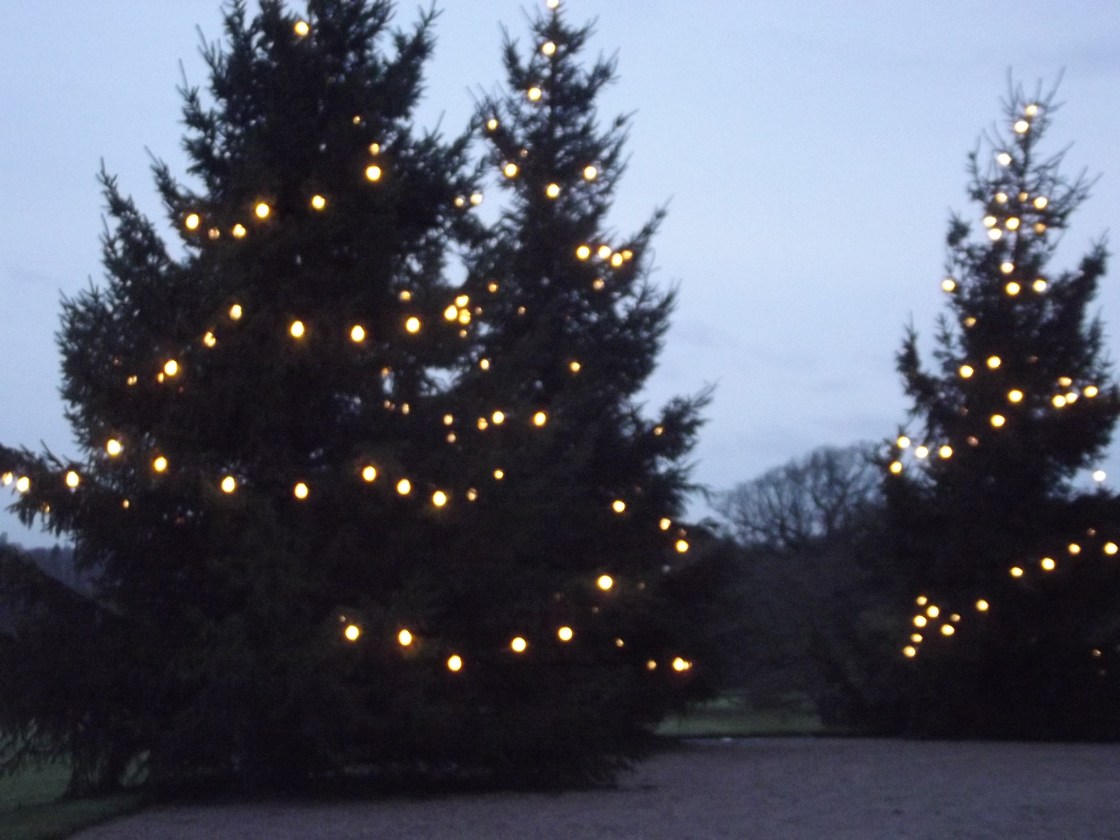
The weather is miserable, strong, gale-force winds, the rain lashing down and just lying on the sodden land, the grey skies promising more… but the gloom is brightened by Christmas lights and smiling faces; the solstice is past so the days must be getting longer, and it is two days until the big day itself, the 25th December.
I really think that for as long as people have lived together in groups, thy must have had special times and celebrations, and I think there must have always been something special to brighten the depths of winter, and celebrate the turn of seasons and it being nearer to spring than autumn. I think people must have always liked lights to brighten the miserable dreariness, and had special food to cheer themselves and maybe celebrate surviving so far into the winter. I think in most traditions there are festivals of joy and brightness and sharing food with family and loved ones and exchanging gifts.
I’m not a Christian but I was brought up in the Christian tradition and love the story of Christmas, the tiny baby born to poor people, not to kings or princes, a baby who grew up to preach love and forgiveness and peace. So I sing along to the Christmas carols (people standing within earshot might not think this is necessarily a good thing!) and enjoy the spirit of Christmas, as well as Christmas spirit!


 Lois Elsden
Lovely post!
It’s quite stormy in Cley at the moment, just what I was hoping for. In the nordic tradition the storm cleans up and out and brings good luck for the coming year.
Happy holidays and a very Merry Christmas to you and yours from North Norfolk!
Dina
God jul! 🙂
LikeLike
Thank you Dina! I hope you have a wonderful Christmas and that the weather is not too dreadful for you! I hope you are safe from floods! I love your tradition and I shall spread it every time someone complains about the nasty weather!
LikeLike
I enjoyed your post. Very wet and windy here too in Buckinghamshire! You might enjoy this piece of writing, taken from the group Passamezzo’s website. They play renaissance music and have a cd featuring Christmas music from that time. I’ve seen them perform and it’s wonderful at this time of year.
Christmas Music in Shakespeare’s England
Christmas celebrations in Renaissance England began with the Advent fast and continued through the feast of Christmas with its twelve days of feasting, masquing and revelry, and ended at Candlemas. (2nd February), when decorations of Bay, Rosemary, Mistletoe & Holly were all taken down.
Books of Christmas carols were printed throughout the sixteenth and seventeenth centuries. These editions usually lack melodies to go with the words although the indication ‘to the tune of’ is sometimes printed at the top of the carol. The word ‘carol’ probably comes from the medieval Latin ‘carula’ which has interchangeable meanings of a round dance or a song and as such it is fitting that so many carols may be set to popular dance and ballad tunes. We begin then with a medley of such tunes, all with Christmas associations, followed by William Dunbar’s translation of the Advent prose, ‘Rorate coeli’.
We set the scene for December with Campion’s ‘Now winter nights enlarge’ and Breton’s description of December before starting the story of the Nativity with Jurie came to Jerusalem, lullabies and songs of adoration.
As the kingdoms of England and Scotland were united when James I became king in 1603, we have included some Scottish carols and readings. (Balulalow, All sons of Adam, O than the fairest)
The advent fast ended on Christmas Eve and the twelve days from Christmas Day until Epiphany (6th January) were traditionally filled with feasting, music, dancing and other revelry. At Court and in the great houses, plays and sumptuous masques would be performed. Many of Shakespeare’s plays were first performed at this time of year. Mummers and ‘guisers’ went from house to house bearing a bowl of wassail (hot spiced ale, sometimes also called ‘lambswool’ if roasted apples were added) decorated with ribbons, garlands (and sometimes a golden apple), caroling, giving blessings and a drink of wassail in exchange for gifts of money or food.
Probably the most well known of the songs of this time is the ‘Coventry’ Carol, taken from a mystery play, remembering the massacre of the Innocents.
Gifts were given on NewYear’s Day rather than at Christmas. (Incidentally, although 1st January was called ‘New Year’s Day’, the New Year did not officially begin till the Feast of the Annunciation on 25th March)
For the feast of the Epiphany, a special cake containing a bean and a pea (sometimes dried, sometimes of metal) was served; whoever found these would be King of the Bean and Queen of the Pea for the evening. Robert Herrick describes this and many other seasonal customs in his collection of verse, Hesperides.
Candlemas, the feast of the Purification of the Virgin marked the end of Christmas and the beginning of Spring: after Candlemas, peasants began to drive their cattle from fallow fields in preparation for sowing. In his Epigram upon Candlemasse daye, Herrick wrote
‘End now the White-loaf, & the Pie
And let all sports with Christmas dye’
Tamsin Lewis 2006
LikeLike
Very cold and windy in Italy as well at the moment…Have a Lovely Christmas!!!
LikeLike