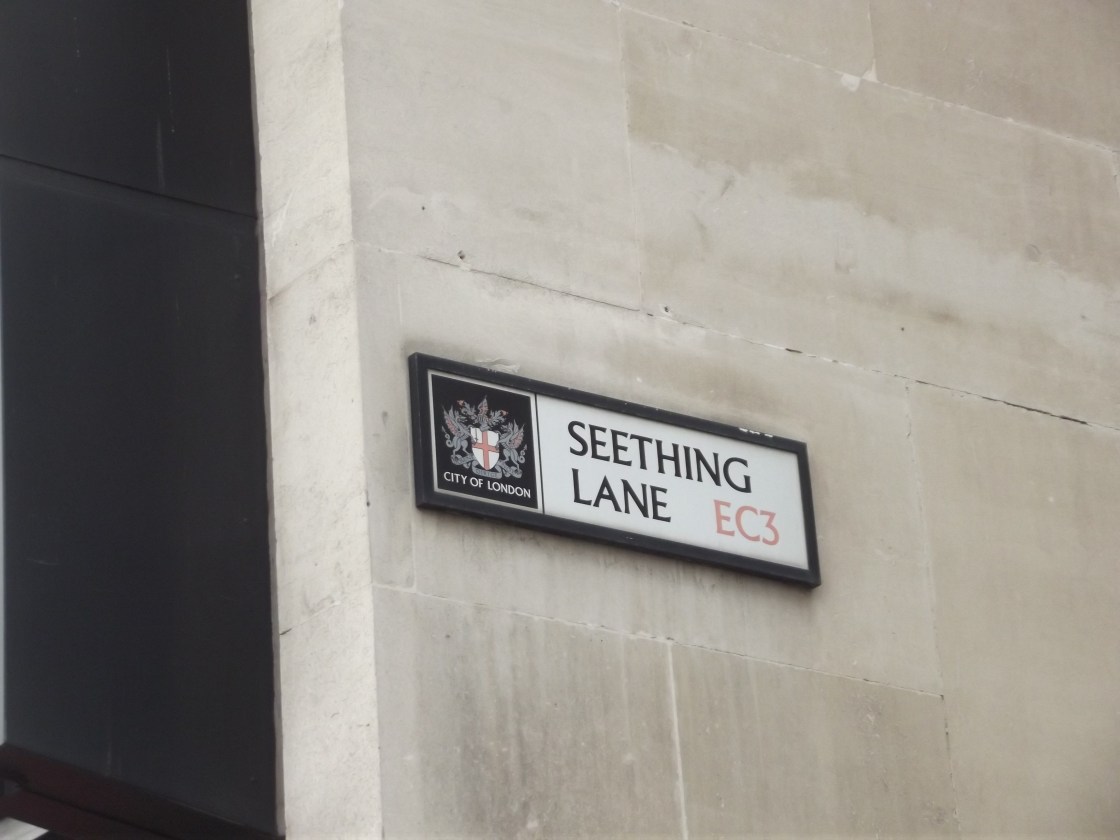
When we visited London last year, I saw the name Seething Lane and was rather amused by it… I didn’t even go down it as we were on our way to somewhere else.
I’ve since discovered that Sir Francis Walsingham had a residence on Seething Lane. I became interested in Walsingham when I read ‘The Watchers: A Secret History of the Reign of Elizabeth I’ by Stephen Alford. Walsingham was a spy-master who conspired to trap Mary Queen of Scots into incriminating herself about her desire for the English throne. He lived in his mansion on Seething Lane until he died in 1590 aged about sixty.
Samuel Pepys, the famous diarist, also lived in Seething Lane: the Navy Office had been built there in 1656, and Pepys moved into a large house there with his family four years later and lived there for many years. Pepys was a worshipper at a little church which was built on the corner of Seething Lane and Hart Street, St Olave’s; the original church on this site was wooden, but a stone church was constructed in the 1200’s. It was badly damaged by bombing in the second world war, but has been restored. It was named for King Olaf of Norway who fought with King Æthelred , known as ‘the Unready’ at the Battle of London Bridge. King Olaf was made a saint and the church was named for him. The entrance into the graveyard of the church, where three hundred and sixty plague victims were buried, is known as is the Gate of the Dead.
Next time we are in London, if we are anywhere near Seething Lane, I shall have to wander down it! Seething, by he way, probably means something to do with chaff because there was a Corn Market nearby, so no doubt the air was ‘sifethen’, or full of chaff as we might say! so-called after the nearby Corn Market


Nice story
LikeLike