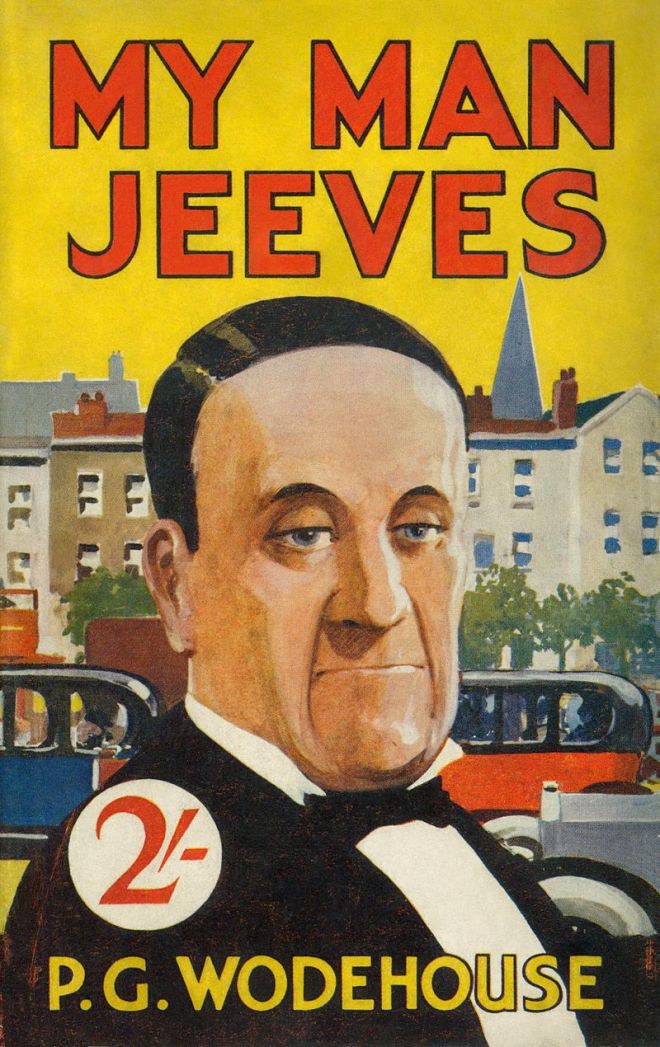
Our book club choice this month was a book by P.G.Wodehouse, ‘Right ho, Jeeves!’… or so I thought, but on arriving to join my friends I discovered that everyone else had read another Jeeves book, ‘The Inimitable Jeeves’, a collection of eleven short stories. Actually it really didn’t matter, because the great thing about the Jeeves stories is that although they are all individual, there is a common set of characters, and the observations one could make can apply to all!
That sounds as if I’m making a negative comment, I’m not; however, because there are the same characters, when we were offering our opinions and were discussing the plots, the comedy, the terrifying aunts and hopeless friends of Bertie Wooster, the superb Jeeves, whichever of Wodehouse’s novels or stories was read could support the same comment. The stories take place in a world far removed from what most people experienced, young ‘toffs’ of independent means on a particular strata of society, leading rather vacuous lives… however the language Wodehouse uses, the cleverness and the observation of his characters make his books still laugh-out-loud funny today. Jeeves, the butler, is forever rescuing Bertie and his chums from the silly situations they place themselves in, and at the same time profits from their silliness without them ever realising.
In case you haven’t come across these comical books, they were written by Wodehouse from 1915 onwards and are about a wealthy young man, Bertie Wooster, and his formidable man-servant, Jeeves. Wodehouse had been writing for some years, and apart from his Jeeves books he wrote series about Psmith, a rather posh socialite and old Etonian, Uckridge who is forever scheming to make money without actually working for any, and Lord Emsworth who appeared in the Blandings books. He also wrote many, many other books and collections of short stories, plays and musicals in his long life.
Pelham Grenville Wodehouse, later Sir Pelham, was born in 1881, and after working in a bank which he didn’t really enjoy he became a writer and found great success with his marvellous array of characters. Having lived in America for a while, he moved to France and was captured by the Germans; he made a series of controversial and perhaps rather foolish broadcasts on German radio which caused a great furore and upset in the UK, and he never returned to England but settled in America and died there at the age of ninety-three.

 Lois Elsden
Well summed up! His narratives are funny indeed, but (I believe) carry profound observations on ‘the psychology of the individual’!
LikeLiked by 1 person
Yes – we thought so too!
LikeLiked by 1 person