All of my books are set in imaginary places, except one, ” Flipside”. It was my first published novel and was set in the village of Lees, now a part of the Pennine town of Oldham. The events I wrote about in “Loving Judah” took place in an imaginary Pennine village, before the main characters drove down to Cornwall to solve various mysteries.. All my other novels, including my Radwinter books, take place in my coastal town of Easthope, the nearby city of Strand, and the more industrialised town of Castair up in the hills.
This imaginary area on the coast is very loosely based on the beautiful coastal area of Northern Ireland. “Farholm”, my imagined island, is obviously inspired by the real and very beautiful island of Rathlin. My other stories take place in Easthope (think Bushmills without the distillery) and along the coast towards a rocky landscape somewhat similar to the Giant’s Causeway. In the other direction my coastline has stunning beaches and lush hillsides. If you haven’t been to Ulster, I urge you to go, obviously not just to see what inspired my imagined locations, but because I’d love you to visit, it’s the most beautiful place you could imagine.
In a previous blog I shared more about this area, and some source material – which you can find here;
http://causewaycoastaonb.ccght.org/natural-heritage/townlands-fieldnames-feature-names/
This is what I wrote last time:
As you may have gathered I’m fascinated by names, all sorts of names, people places, days, months… I just find it so interesting to delve into the origins of named things. So, I was particularity interested to find some information about a place I know well, and love a lot, the Causeway Coast and Glens of Northern Ireland. I was even more particularity interested because it includes among the excellent photos, old and new, an areal shot of a mystical and magical place, Lisanduff. Lisanduff which means dark fort, or dark enclosed space, is a little known but very important earthwork right on the edge of the sea.
The information I was looking at was about the place names of this beautiful, stunning area;the names of places have a variety of origins, some are simply named after a person who lived/worked/owned the area, a person who may be remembered, maybe long forgotten apart from the name tagged to a location, or connected with an ancient myth.
This coastline has been settled, attacked, plundered and defended by many different people over the thousands of years it has been inhabited, and those people leave their traces in names derived from their languages, ancient Celtic tongues, Gaelic, Scots, Viking, Anglo-Norman.
Events too can leave their mark, battles or just little local skirmishes between tribes folk, may leave their memory in a name. Something which was once in a place but has now vanished in a physical sense, may live on in a name, a sacred place, a palace, a fort, a castle, a town or church… Maybe a trade was carried out in that place, mining, farming, fishing, maybe there was a ford where people crossed a river. Perhaps there once was a spring or well, a holy pool which people visited and made offerings or sort healing watery places and the memory of what happened as well as the water has been culverted, lost and forgotten except for the name. Sometimes these events may not have actually happened, sometimes they are merely myths, old legends and tales handed down from a distant story-teller.
Find out more about the townlands, fieldnames and feature names of the Causeway Coast here:
http://causewaycoastaonb.ccght.org/natural-heritage/townlands-fieldnames-feature-names/
As you may have gathered I’m fascinated by names, all sorts of names, people places, days, months… I just find it so interesting to delve into the origins of named things. So, I was particularity interested to find some information about a place I know well, and love a lot, the Causeway Coast and Glens of Northern Ireland. I was even more particularity interested because it includes among the excellent photos, old and new, an areal shot of a mystical and magical place, Lisanduff. Lisanduff which means dark fort, or dark enclosed space, is a little known but very important earthwork right on the edge of the sea.
The information I was looking at was about the place names of this beautiful, stunning area;the names of places have a variety of origins, some are simply named after a person who lived/worked/owned the area, a person who may be remembered, maybe long forgotten apart from the name tagged to a location, or connected with an ancient myth.
This coastline has been settled, attacked, plundered and defended by many different people over the thousands of years it has been inhabited, and those people leave their traces in names derived from their languages, ancient Celtic tongues, Gaelic, Scots, Viking, Anglo-Norman.
Events too can leave their mark, battles or just little local skirmishes between tribes folk, may leave their memory in a name. Something which was once in a place but has now vanished in a physical sense, may live on in a name, a sacred place, a palace, a fort, a castle, a town or church… Maybe a trade was carried out in that place, mining, farming, fishing, maybe there was a ford where people crossed a river. Perhaps there once was a spring or well, a holy pool which people visited and made offerings or sort healing watery places and the memory of what happened as well as the water has been culverted, lost and forgotten except for the name. Sometimes these events may not have actually happened, sometimes they are merely myths, old legends and tales handed down from a distant story-teller.
Find out more about the townlands, fieldnames and feature names of the Causeway Coast here:
http://causewaycoastaonb.ccght.org/natural-heritage/townlands-fieldnames-feature-names/
By the way, the only scene of a very romantic interlude which I have ever actually described (blushing to remember it) took place in a place based on Lisanduff. It’s in “The Stalking of Rosa Czekov”.
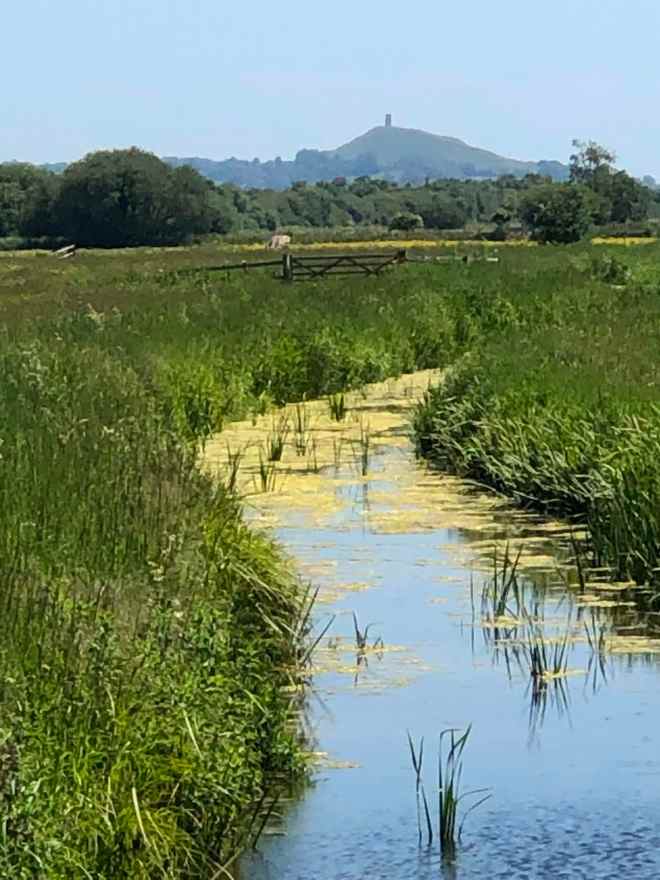
My featured image was taken on Shapwick Moor in Somerset, looking towards Glastonbury Tor as you no doubt recognised.

 Lois Elsden