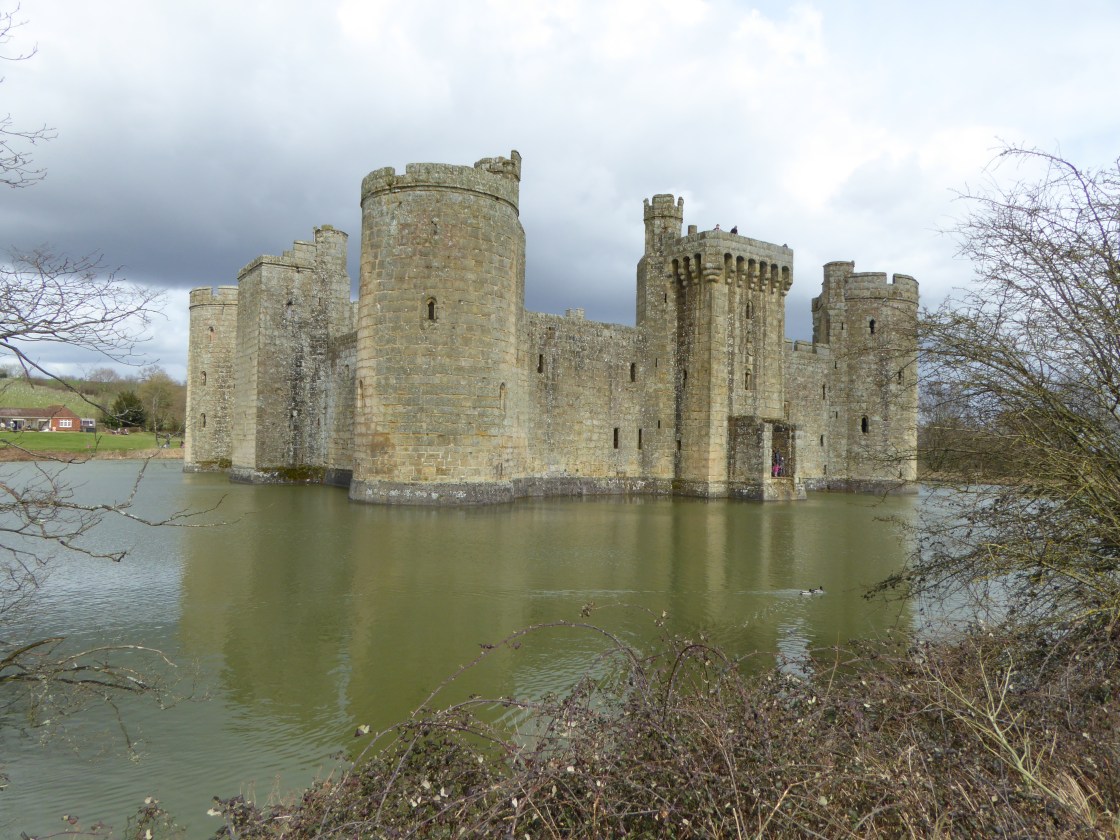
Bodiam Castle is about six and a half centuries old and is a wonderful place to visit if you’re in East Sussex; it has a splendid moat, full of huge catfish and carp, and although ruined has its towers and walls and battlements. it doesn’t seem to have seen much actual action – a siege was ordered during the War of the Roses, but may not have happened, and after the English Civil War it was partially dismantled, but in an organized way, not blown to bits by canon during a battle. It is now owned by the National Trust, and so as well as the gift shop and café there is also a second-hand book shop.
In the little bookshop, I picked up a small booklet entitled ‘Local Boy Makes Good’ and subtitled, ‘the story of St Cenydd and his church from the sixth century to the present day’. I had never heard of St Cenydd; I’ve heard of the Scottish St Kenneth, the Anglicised name of St Cainnech of Aghaboe who was born around 515 and died at the great age of eighty-five; he was actually born in Ireland, went to Wales, went to Rome, and then to Scotland where he built or had built a church in what is now St Andrews.
St Cenydd has a more exotic story attached to him, although whether its true of not who can tell! if he actually existed he was born some time in the sixth century, and may have been the son of Gildas who wrote the history of King Arthur. However, so the little booklet tells me, there is another story that Cenydd was the son of Prince Dihocus of Brittany, and his own daughter. When he was born, the prince and daughter were visiting Wales, and just as Moses was disposed of in the Bible, so baby Cenydd was put in a reed basket and put in the River Lliw… like all such stories what happened next is pure fantasy, he was looked after by seagulls, given a breast shaped bell by an angel, by which he could drink a doe’s milk, and lived on herbs, his baby clothes magically growing with him as he grew. Maybe he went to a religious foundation to be educated, or maybe some other angels came and schooled him… Eventually, after travelling from place to place where springs would spurt wherever he stopped to refresh him, he settled at a place called Llan-Genydd, after him, and founded a church. There is a spring near the church, which became the village well until modern water management made other arrangements, but it is still there and the modern church uses it for their communion service.
I’ve never been to Cenydd, never even heard of it until i picked up the little church booklet; if you want to know more about the church, here’s an interesting link:
http://www.the-gower.com/villages/Llangennith/llangennith.htm


Oh do visit Gower, it’s spectacular 🙂
LikeLiked by 1 person
I went years and years ago… but it was a miserable wet day… Now I want to go when its sunny and lovely! With a picnic!
LikeLiked by 1 person
Plenty of wonderful things to see and do….
LikeLiked by 1 person
And St Cenydd’s church!
LikeLike
Yes, in Llangennith (Cenydd’s church), good campsite nearby and standing stones all over the place. The Welsh word ‘llan’ is often translated as church but it really means a holy site and many Christian churches have been built on much older sacred sites. The actual Welsh work for church is ‘eglwys’.
LikeLike
Oooh, standing stones! … is ‘eglwys’ from French? Did the naughty Normans impose their language on the Welsh too?
LikeLiked by 1 person
I don’t know but suspect Latin rather than French, Welsh is a mixture of Brythonic and Latin. Fenestre and fenestr both have a Latin root. I struggle with French because there are so many similarities that I switch between French and Welsh when I try to speak it. Breton is more or less identical to Welsh. Predates the Normans by a thousand years or so.
LikeLike
Thanks… so it’s a much older word than I realised!
LikeLiked by 1 person
Welsh is around 2000 years old and didn’t really go through all the changes that English has, so it’s relatively easy to read archaic Welsh, whereas old English is like another language and modern English has absorbed so much from all over the place.
LikeLiked by 1 person
Gosh, you’re a mine of information! A Welsh gold mine of course!
LikeLiked by 1 person
There’s a Welsh gold mine called Dolaucothi near Talley Abbey which was established by the Romans, one of the reasons they invaded Britain, along with the Cornish tin mines. 😀
LikeLiked by 1 person
Is that where the gold for the queen’s wedding ring comes from?
LikeLiked by 1 person
I don’t think so. The mine isn’t operating anymore, just open to tourists. I think the queen’s gold comes from North Wales
LikeLiked by 1 person